
Tag Archive for: Toddler

Is your child throwing temper tantrums?

Most toddlers do!

For parents, however, it can be irritating and challenging to deal with. Perhaps you are wondering what the norm is for temper tantrums, how they differ at each age, and how you can manage them as a parent.

In this comprehensive guide, you’ll learn all about temper tantrums at each age and how you can handle them! Read on to learn more!

Table of Contents

Tantrum vs. Meltdown – What’s the Difference?

Tantrums and meltdowns may look very similar at a glance. In fact, many people think they are the same thing. Nonetheless, we’re here to correct this—tantrums and meltdowns are not the same.

Why does this distinction matter?

Because one is on purpose and the other is not. If you punish children for involuntarily breaking down, you could harm them emotionally. Let us explain.

What is a Tantrum?

A tantrum happens when a child is trying to get something s/he wants or needs. The child will have an outburst that involves yelling and crying. When a child has a tantrum, s/he may even stop in the middle to see if the parent or caregiver is looking at him/her and then continue with the outburst.

This is not an appropriate way to express feelings. Often, children will stop when they get what they want or when they realize that having a tantrum won’t solve the problem.


What is a Meltdown?

A meltdown happens when a child is overwhelmed by sensory overload.  Meltdowns may involve yelling, crying, or shutting down.

For example, meltdown may happen after a busy day at an amusement park. While a child may have had tons of fun, s/he was also processing a lot of sounds, sights, tastes, and textures.

Your child can not control a meltdown that is a result of sensory overload.


toddler tantrums

How to Determine If Your Child is Having a Tantrum vs. Meltdown

If you are having a difficult time trying to determine whether your child is having a tantrum or a meltdown, try to evaluate your child’s situation.

For instance, what exactly are you doing when your child has a tantrum or meltdown? You may be in a busy place, such as a mall. Perhaps you and your little one ran errands all day, and now your child is tired. That’s a meltdown.

On the other hand, if your child wants you to buy him/her something and you say no, your child is probably throwing a tantrum, trying to persuade you buy it for them.

To truly determine how your child is reacting, though, tune in to your child’s feelings. You may even sense when these intense feelings are coming on and work to prevent them from erupting by helping your toddler manage his/her complicated emotions or distracting him/her.

How to Deal with Meltdowns

[Jump to Infographic]

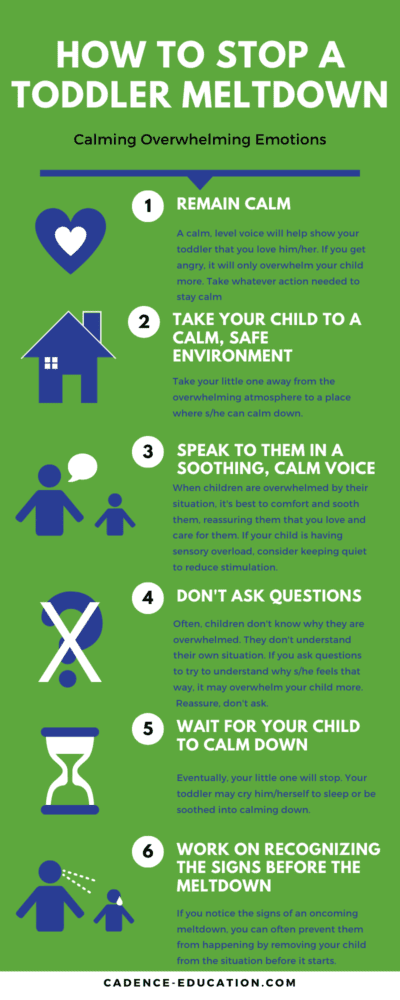
When your child is having a meltdown, help your child find a safe, quiet place to calm down.

For example, if you are in a store while your child starts having a meltdown, step outside or go to your car until your child can calm down.

Be a calming presence to your little one. Try not to talk too much, or keep your voice soft and soothing. Remember, a meltdown is caused by overstimulation. So try to reduce the stimulation to stop the meltdown.

What Does it Mean When Your Child Has Meltdowns Regularly?

If your child seems to be having meltdowns regularly and without apparent sensory overload, it may be due to stress.

Could your child be under stress? If so, what could be causing the stress? Sometimes, it may be because parents are fighting, one parent is sick, or there is some disharmony in the house.

Keep in mind that even toddlers can sense when parents are stressed out. If you are stressed, it may inadvertently cause meltdowns. If that is the case, talk with your child. Be as honest with them as you can, but use language s/he can understand.

Healthy communication will help to ease any anxiety they might have. Be a comforting, calming presence to your little one, showing him/her that you love him/her.

how to stop a toddler meltdown


Why Do Children Throw Tantrums? An Explanation for Every Age

how to stop temper tantrums

Temper tantrums can be stressful for both the parent and child. Nonetheless, as the CDC suggests, understanding and responding appropriately to the tantrum can improve behaviors over time. So, before you throw your hands up in defeat, learn about the various reasons why children of different ages throw temper tantrums. After, we’ll discuss how to handle sporadic tantrums.

baby tantrums

Of course, all babies cry. Usually, it’s because they have a dirty diaper, are hungry, or are tired. Most parents know what it sounds like when their baby is crying because s/he is hurt or uncomfortable. If your baby is crying because of any of these reasons, it’s not considered a tantrum.

Remember, too, that a baby’s only form of communication is crying. If your child is under one year old, s/he is probably not throwing a temper tantrum. Rather, your little one may be tired, hungry, or getting sick. If your baby is often crying and you are unsure why talk to your pediatrician.

1 year old tantrumsMost babies will throw their first tantrum around one year old, give or take a few months. So rest assured that this is normal behavior!

In fact, most toddlers throw tantrums because they are trying to express themselves. Toddlers have a limited vocabulary at this age, making it harder for them to express themselves properly.

Therefore, your one year old may be throwing a tantrum simply because s/he is hungry or tired. On the other hand, your child might be having a tantrum because s/he is frustrated or jealous.

2 year old tantrums

The terrible twos! There’s a reason for this alliterate term. Two-year-olds are usually the most prone to throwing temper tantrums.

Just like the one-year-old, a two-year-old will often throw a tantrum because s/he cannot communicate what s/he wants effectively. Sometimes, your child might not even know what s/he wants. Sometimes, it can become overwhelming for them, and they have a meltdown.

On the other hand, if your child is throwing a temper tantrum because s/he is frustrated because s/he isn’t getting his/her way, you must stand your ground. Don’t encourage bad behavior.

3 year old tantrums

Tantrums for your three year old will usually be caused by the same things that trigger a two-year-old’s tantrum. In other words, your three-year-old may be frustrated, or s/he is having a difficult time expressing him/herself.

Another cause of toddler tantrums is unrealistic expectations or rigid rules. If a child feels that you are putting too much pressure on him/her, it may cause a tantrum to ensue. It’s crucial to find the right balance as a parent. At the same time, your child must learn how to express his/her feelings without exploding.

4 year old tantrum

By this age, temper tantrums should decrease because at this age children are able to communicate their feelings.

However, some four-year-olds still throw tantrums for the same reasons a two or three-year-old will. Often, adults may think that their four-year-old is mature enough not to throw a tantrum. Sadly, if you have thought this, you may be overestimating your little one.

It’s a good idea to talk to your child and help him/her to understand that s/he is in charge of his/her emotions, rather than the feelings being in charge of your child.

Additionally, your child may have specific triggers that cause stress. If certain situations, classes, or activities trigger a tantrum, talk with your child about it. Is it too much for them to handle right now?

Lastly, four year olds could throw temper tantrums because they want something they can’t have.

5 year old tantrums

Now that your child is five years old and well on his/her way to entering elementary school, most tantrums will have ceased by now. However, some children still tend to throw tantrums. Don’t worry—it’s still normal at this age!

Your five year old could be throwing a tantrum because s/he wants something s/he cannot have, is stressed out, hungry, or tired.

If you know these are not the causes of the tantrum, talk to your child to see what may be stressing him/her out. It could be school, family problems, or something else.

On the other hand, if your child is being stubborn or is upset because s/he isn’t getting his/her way, it’s probably because you’ve told him/her no. Don’t give in if your child throws a tantrum. It is more productive to ignore bad behavior.

6 year old tantrumsIf your child is still throwing tantrums by the age of six, it could be because they have a hard time controlling their emotions. Some children feel emotions more strongly than other children.

Another reason may be because your six-year-old has a difficult time explaining his/her feelings or experiences.

Other triggers may be anxiety over certain activities or situations like trouble in school, or overstimulation.

Talk to your child to try to understand what is bothering him/her. Try to pinpoint what situations, activities, or experiences may be causing the anxiety, overstimulation, or loss of emotional control.


How to Stop Temper Tantrums

how to stop temper tantrums

Identify and Stop Baby Tantrum Triggers

As said before, baby tantrums are inevitable. Children this small can not effectively communicate their problems or thoughts.

For this reason, it is up to the parent to investigate and find the source of their grief. The following questions are a few things you should consider if your baby is throwing a tantrum:

  • Is your little one hungry, tired, or does s/he have a messy diaper?
  • Is your little one too hot or too cold?
  • Could s/he be getting sick?

Some babies throw a tantrum because they are frustrated. If that is the case, help your baby achieve his/her goal or remove the frustration. If your baby is afraid or anxious, cuddle, and comfort your little one, removing him/her from the stressful situation.

Remember, your baby cannot yet communicate with you. The only way s/he can express him/herself is to cry. If your baby is crying intensely or excessively, it’s probably because s/he is trying to tell you something.

However, if your baby is crying because s/he was playing with a confiscated toy, try to find a distraction for him/her. For instance, get your baby excited about a different toy.

Stop and Prevent Further Toddler Temper Tantrums

[Jump to Infographic]

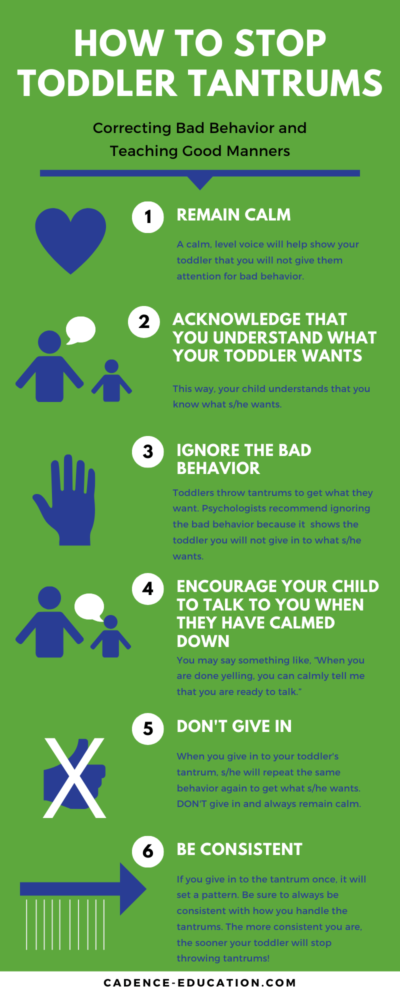
Whatever you do, remain calm. If you try to punish or threaten your child while s/he is already in the throes of a tantrum, the tantrum may escalate. As mentioned, children who have lost control of their emotions may feel anxious or afraid of how they feel. If you yell, it may make the situation worse. Therefore, your first step should be calming down your child without giving in to bad behavior.

Here is how to stop each type of tantrum:

  • Fatigue/frustration tantrums. Give your child a nap or snack, offer help, or take a break from whatever your toddler is doing.
  • Attention-seeking/demanding tantrums. This is often a response to you saying no. Smile, reassure your child you love him/her, make him/her feel safe, and calmly offer to talk to him/her again when s/he is calmer. You may say something like, “When you are done yelling, you can calmly tell me that you are ready to talk.”
  • Refusal tantrum. This happens when the child says no, usually because you’ve asked him/her to do something s/he doesn’t want to do. Try to go easy on your little one if the situation isn’t too critical. If it’s snack time and your child doesn’t want to eat, for instance, don’t force him/her to do it anyway if it will trigger a tantrum.
  • Disruptive tantrums. These usually occur when children are acting up. Place your child in a room by him/herself and give him/her a time out for a few minutes. If you are not at home, take your child outside. Help your child to understand that s/he will not get attention from you or anyone else from misbehaving. Sometimes, toddlers will check to see if you are paying attention to them when they are throwing a tantrum.
  • Rage tantrum. This is when your child loses control physically and emotionally. S/He may scream, kick, or hit, potentially harming him/herself or others. Some toddlers don’t understand the intensity of their own emotions. If you are able, hold your child securely and tell him/her that you will continue doing so until s/he calms down and gains control over him/herself.

Even more, according to the Centers for Disease Control and Prevention, ignoring a temper tantrum can be a positive way to stop them.

Why?

It shows your child that you will not give him/her attention for misbehaving.

If your child is old enough to communicate effectively, talk to him/her. Your child may experience tantrums because s/he is stressed about something s/he is having a hard time explaining.

how to stop toddler tantrums


How to Stop Toddler Bedtime Tantrums

Toddler bedtime tantrums can make bedtime very difficult! Many children make bedtime difficult because they don’t want to go to bed. This is a type of refusal tantrum.

Toddler bedtime tantrums are very common. In fact, bedtime is a learned routine and will get better with consistency.

The best way to stop it is to develop a regular bedtime routine and stick to it every night. For instance, your child’s bedtime routine may start with taking a bath, then move on to brushing teeth, putting PJs on, and reading a bedtime story. Make sure that your child’s bedtime routine is the same every night and takes place at the same time. This way, your child will get used to the idea of winding down for sleep.

Be sure to explain to your toddler what happens next in the routine so s/he knows each step before it happens.

Additionally, if your child doesn’t seem tired at bedtime, you may consider getting rid of nap time. Every child is different, but most children outgrow naps around three years of age. If you are unsure about whether or not your child should have nap time, ask your pediatrician.

Lastly, be sure to reward good behavior, such as with a reward chart. For instance, when your toddler goes to bed without throwing a tantrum all week, perhaps they can stay up an extra thirty minutes on Saturday night, get a new toy, go out for ice cream, get a new bedtime book, or enjoy a trip to the park. A reward chart may encourage good behavior.

Remember, don’t give in to the tantrum. If you allow your child to stay up when they throw a tantrum, s/he will no doubt feel that if s/he throws a tantrum every night, s/he can stay up. This will only start bad habits. Always remember to remain calm and do not encourage bad behavior.

Advice for Parents: How to Deal with Tantrums

Some toddlers throw tantrums often. Therefore, you will have to know more than how to stop tantrums; you also need to know how to deal with toddler temper tantrums.

For instance, it’s always a good idea to have a plan for when your child has a meltdown or tantrum (see the infographics). Your goal should always be to keep your child safe and guide his/her behavior, so the temper tantrum is less likely to happen in the future.

Additionally, find ways to remain calm and keep your composure. Dealing with tantrums can be exhausting and irritating. However, when you yell at your child or give in to your toddler’s demands, it can worsen the situation and even teach your child bad habits.

If tantrums continue to get worse or are becoming too much to bear, you may need to talk to your child’s pediatrician. Keep reading to learn about some tantrum red flags to look out for.

Toddler Tantrums: When to Worry

why do toddlers throw tantrumsAccording to WebMD, there are five red flags when it comes to toddler temper tantrums and when to worry. Here they are:

Firstly, if your toddler is showing aggression toward you, a caregiver, or an object during all or most of his/her tantrums, it may signal a disruptive disorder.

Secondly, children who harm themselves deliberately during a temper tantrum (biting or scratching themselves, banging their heads against a wall, or kicking something in an attempt to hurt themselves) were more likely to have major depression.

Thirdly, preschoolers who have, on average, ten to twenty tantrums a month at home or who have more than five tantrums a day outside of the home may have a serious psychiatric problem.

Fourthly, if children constantly have temper tantrums that last more than twenty-five minutes, it may be a sign of another underlying problem. Keep in mind, though, that a child may have a very long tantrum and be completely normal. It’s when a child continuously has tantrums exceeding twenty-five minutes that a child may have another issue causing it.

Fifthly, if a child cannot calm him/herself down after a tantrum, it may be another red flag that a problem is occurring. These children often require some bribery or physical removal from the situation to calm them down.

If your child is experiencing one or more of these red flags, it may be a sign that s/he has some mental health problem. So what should you do?

Talk to your child’s pediatrician to see if there could be an underlying problem. Also, consider visiting a pediatric neuropsychologist for a broad assessment or see a child psychologist, who will help the child develop emotional control.

Rest assured that most children have tantrums. In fact, seven out of ten 18-24-month-olds throw tantrums, and about 75% of 3-5-year-olds have tantrums as well.

Does Your Child Go to a School that Encourages Good Behavior?

Sometimes, schools and daycares do not have the best system in place when a toddler throws a tantrum. For instance, some teachers may think the child is acting up and discipline him/her for throwing one. Other teachers may be too lenient. If your little one throws a tantrum every day before going to school, the school may be overwhelming or stressful for your little one.

So what’s the solution?

You must find a school or daycare program that encourages good behavior through positivity and a nurturing, loving atmosphere.

For example, Cadence Education makes this a priority to implement in every classroom. Through exceptional education, fun-filled days, and an environment as nurturing as home, your child will no doubt feel safe, happy, and comfortable at Cadence Education!

Additionally, these schools offer parents meaningful communication, so you are always up-to-date with your child’s behavior, activities, and personal growth. Through weekly emails and monthly progress reports, you will always be involved in your child’s daily activities.

With daycare programs for babies and toddlers, as well as kindergarten-readiness programs, your little one will surely get the fun educational experience they deserve.

Find a school near you and schedule a visit today!

There’s so much going on for a two-year-old child who’s absorbing every bit of information around them while relishing the joys of independence. At this age, parents can expect to encounter big feelings and a lot of talking and movement. For those just figuring out parenting themselves — or even the most experienced ones — setting a daily routine can help rein in those sudden emotional outbursts and make days a bit more predictable. 

This guide discusses tips on creating a two year old’s schedule, and how partnering with a daycare can help make things so much easier. 

Why Structure is Important for 2 Year Olds

How essential is a schedule for toddlers? Small children who have routines tend to feel more stable, secure, and trusting of their parents and caregivers. Because toddlers are still developing a deeper grasp of the events around them, a schedule can also help them understand what is expected of them, so they can behave accordingly. 

Setting a daily schedule for a two-year-old child brings many benefits for both the child and the parent or caregiver, including:

Stable body clock

A consistent routine can help children and their bodies get accustomed to daily basics, such as eating healthy and full meals, taking naps and sleeping well at night, enjoying outdoor time and play, following a regular potty time, and staying relaxed and calm during down times. 

Social, cognitive, and emotional development

Routines that are predictable, have the right transition cues, and offer enough room for flexibility can help reduce tantrums and other challenging behaviors. Children with routines are often more engaged with the people around them and their environment and respond more positively in case changes happen. 

Established expectations

Schedules teach small children to expect certain activities for the day, so there’s less of a power struggle when, for example, toys need to be packed away for nap time or when it’s time for a bath. It’s also good for the busy parent or caregiver because a routine serves as a reminder of important tasks, like ensuring the child takes their vitamins, doesn’t miss a daycare activity, or doesn’t run out of milk and healthy snacks. A schedule creates a calmer household, reducing anxiety and stress for both the child and the parent. 

Stable learning environment

Everyday routines offer plenty of teaching moments for two year olds. For instance, you can teach young children to brush their teeth before sleeping or wash their hands before eating. Each activity on the schedule is also an opportunity to chat and ask questions/provide answers to help them develop academically and build strong communication skills. 

Sample Daily Schedule for 2 Year Olds

Parents benefit a lot from enrolling their little kids to daycare. The kind of structure that experienced early learning providers create helps busy caregivers get on with their work day while ensuring that children also develop the right way. If you are considering enrolling your child in daycare, here’s an example of a schedule your two-year-old child may have. 

Morning

  • 9:00 AM – Arrival and breakfast time. Children are greeted by their teachers as they arrive and can play quietly while waiting for their friends to come.
  • 9:00 AM to 9:15 AM – Time for a healthy snack to start the day right.
  • 9:15 AM to 9:30 AM – Circle time. Start the day as a group and talk about what’s in store for the day. You can sing songs, share stories, or read a book out loud.
  • 9:30 AM to 10:00 AM – Fun activities. Depending on the plan for the day, toddlers can explore and play on their own or engage in a teacher-led group activity. 
  • 10:00 AM to 10:30 AM – Outdoor play. 
  • 10:30 AM to 11:00 AM – Lunch break. Kids together learn to wash their hands, set tables, and prepare to have lunch.

Afternoon

  • 12:00 PM to 2:00 PM – Quiet time. Most children will take a nap, while others enjoy their time quietly by playing on their own or looking at books. 
  • 2:00 PM to 2:10 PM – Snack time. 
  • 2:10 PM to 2:50 PM – Activity time. Similar to the morning activity hour, kids can engage in theme-based, teacher-led activities or explore on their own.
  • 2:50 PM to 3:20 PM – Outdoor play. This can be a solo or group activity, depending on what the teacher has planned for the afternoon.
  • 3:20 PM to 4:00 PM – Group time. Children come together before the day ends for another group session. 
  • 4:00 PM onwards – Pick up time. 

What if we haven’t enrolled in daycare yet?

No worries! If you haven’t enrolled in daycare yet and are looking for a schedule you can adopt for your two-year-old child at home, the sample schedule can also work, with some modifications depending on your available resources. Most stay-at-home parents devote a certain space in their home for toddler learning and activities and then just take their little ones out to the yard or the nearby park for outdoor time. 

The activities don’t have to be fancy, as what’s really important to the schedule is a predictable structure and your involvement as caregiver and educator. But if you have the opportunity to enroll at a daycare near you, that would be most beneficial for both you and your little one. 

Build an Effective Schedule For Your 2 Year Old with Cadence Education

Cadence Education’s toddler care program is tailored to the developmental needs of two-year-old children, offering a fun and loving environment that is as nurturing as home. Activities spark creativity and confidence by allowing children unique opportunities for self-expression, alongside academic nurturing to prepare them for kindergarten. Contact us today to learn more about our flexible part-time and full-time daycare programs.


Starting daycare is a big step for you and your toddler. It’s a time filled with excitement, nerves, and many questions. While this new chapter can feel overwhelming, working out how to prepare a toddler for daycare can streamline the transition. 

Daycare introduces your child to new friends, routines, and opportunities for learning and growth. With thoughtful planning, you can help them feel confident and ready to embrace this new experience. From setting up routines to easing separation anxiety, preparing a toddler for daycare effectively ensures your little one starts on a positive note—read on and find out how to make this rewarding experience less disruptive. 

Getting Your Toddler Ready for Their First Day of Daycare

The first day of daycare is a milestone, and careful preparation can help ease your toddler into their new environment. Here’s how to set your little one up for success: 

  • Visit the daycare together: Before the first day, take your toddler to visit the daycare. Show them the classrooms, playground, and other spaces they’ll spend time in. If possible, introduce them to their teacher. This helps familiarize your child with the setting and reduces the fear of the unknown. You can take pictures during the visit and talk about them later to remind your toddler of the fun things they saw.
  • Establish a morning routine: Consistency helps toddlers feel secure. Start practicing a morning routine a couple of weeks before daycare begins. A simple routine might include waking up, brushing teeth, getting dressed, eating breakfast, and packing their bag. Keeping the morning predictable can help reduce stress and make the transition smoother.
  • Talk about daycare positively: Begin talking to your toddler about daycare in the days or weeks leading up to their start date. Describe it as a fun place where they’ll make new friends, play with toys, and learn exciting things. Always assure them that you’ll be there to pick them up at the end of the day. Keep the conversation upbeat and answer any questions they might have in a calm, comforting tone.
  • Practice separation: If your toddler isn’t used to being away from you, practice short periods of separation. Start by leaving them with a trusted caregiver or family member for a few hours. This helps your child gain confidence, knowing that you’ll always come back for them, which can make the daycare drop-off less intimidating.
  • Pack comfort items: Send your toddler to daycare with a small, familiar item from home such as a stuffed animal, blanket, or family photo. A comfort item can ease anxiety and remind them that home is never too far away.
  • Develop a goodbye ritual: Goodbyes can be hard, but a quick and reassuring routine can make them easier. Create a special ritual, like a hug and a wave from the same spot each morning. Keep it short and sweet—lingering too long can make it harder for you and your child to adjust. 

Preparing Toddlers for Daycare: Common FAQs

Starting daycare often brings up questions for parents. Here are some of the most common ones when working out how to prepare toddler for daycare: 

1) How long will it take my toddler to adjust?

Adjustment times vary for every child. Some toddlers settle into daycare within a week or two, while others might take a month or longer. Be patient and consistent. Offer encouragement and celebrate small wins, like a successful drop-off or a day without tears. If your toddler struggles for an extended period, talk with the daycare to develop a plan that supports their needs. 

2) What should I pack for my toddler?

Each daycare has unique requirements, but here’s a general checklist to get started when working out how to prepare for daycare toddler packing: 

  • A change of clothes.
  • Diapers or pull-ups, if needed.
  • Snacks or lunch (if the daycare doesn’t provide meals).
  • A water bottle or sippy cup.
  • Any comfort items your child might need.
  • Sunscreen or outdoor gear, depending on the season. 

3) How do I handle separation anxiety?

Separation anxiety is common in toddlers starting daycare. Acknowledge their feelings with empathy but stay confident. Tell them it’s okay to feel nervous and remind them you’ll return soon. Trust the daycare staff to help soothe your child after you leave. Remember, consistency with drop-offs is key to building trust. 

4) How can I support my toddler’s learning at daycare?

Ask the daycare staff about the activities and skills they’re working on and try to reinforce them at home. If the daycare is focused on sharing, for example, practice sharing toys during playtime at home. This connection between home and daycare helps your child feel more engaged and confident in their new routine. 

5) How do I communicate with daycare staff?

Good communication with daycare staff is central to a smooth overall experience. Share important details about your toddler’s preferences, routines, and any changes at home that might affect their behavior. Don’t hesitate to ask for updates on how your child is doing. Building a strong partnership with the caregivers ensures your child gets the support they need to thrive. 

6) What if my child doesn’t seem to like daycare?

It’s normal for toddlers to have ups and downs while adjusting to daycare. Keep an open dialogue with their teachers and look for solutions together. Sometimes small changes, like adjusting nap schedules or offering extra reassurance, can make a dramatic difference. If problems persist, explore other daycare options that fit your child’s personality and needs. 

Toddler Daycare at Cadence Education

Choosing the right daycare is a major decision, but it can also be a wonderful opportunity for your toddler to grow and thrive. A quality daycare program provides a supportive and fun environment where children can develop core skills, build confidence, and enjoy new experiences. 

Cadence Education, our Toddler Program focuses on nurturing young children’s mental, emotional, and physical growth. Through activities like art, music, reading, and outdoor play, your child can explore their creativity, strengthen social connections, and embrace independence in a safe setting. 

Accredited daycare centers at Cadence offer excellent curricula and staff training, giving you peace of mind that your child receives the best care possible. If you’re ready to help your little one take this exciting step, explore options near you and prepare for a successful daycare journey today.

Biting is a common phase many toddlers go through, but it can be challenging for parents, caregivers, and daycare staff to handle. One moment your child is playing happily, and the next, they’ve sunk their teeth into another child. While biting can feel alarming, it’s often just a sign of a young child learning to deal with emotions, express needs, or respond to their environment. 

Developing an understanding of why toddlers bite and taking proactive steps to address this behavior can help promote a positive and supportive environment for everyone involved. Whether it’s frustration, teething, or the lack of words to express feelings, toddlers bite for reasons that are rarely intentional. This guide explores practical strategies to stop toddlers from biting at daycare, helping children express themselves more effectively and build better social habits. 

Why Do Toddlers Bite at Daycare?

Biting is a natural, although sometimes surprising, behavior in young children. Toddlers are still learning how to handle their emotions and express their needs. This lack of communication skills often underpins biting. A toddler might bite because they feel scared, frustrated, or overwhelmed and don’t know how to say so. 

Teething is another common cause of toddlers biting. For younger toddlers, the discomfort of new teeth coming in can drive them to bite objects—or even people—for relief. Others might bite out of curiosity, exploring the world around them with their mouths, which is a natural development stage. 

Sometimes, biting is a reaction to their environment. A crowded daycare or difficulty sharing toys can create situations where a toddler uses biting as a way of asserting control. Additionally, toddlers might bite to gain attention, especially if they notice a strong reaction from adults or peers. While biting is rarely intentional harm, it can cause stress for both the child biting and those around them. 

What to Do About Toddler Biting at Daycare?

When biting at daycare occurs, address the situation calmly and quickly. Reacting with frustration or anger can escalate the problem and confuse the child. Here’s how to handle biting effectively: 

  • Address the behavior immediately: Use simple phrases like, “No biting. Biting hurts.” This makes it clear that biting is not acceptable without overwhelming the child with lengthy explanations.
  • Focus on the victim first: Give attention to the child who was bitten. Clean the bite area and provide comfort. This shows that biting doesn’t result in extra attention for the child biting.
  • Help the toddler biting understand: After addressing the victim, turn your attention to the toddler who was biting. Explain in simple terms why biting is wrong—“Biting hurts people. We use words to say how we feel.”
  • Identify the trigger: Try to determine why the child bit in the first place. Were they frustrated, tired, or hungry? Understanding the cause can help you prevent further incidents.
  • Model positive behavior: Show toddlers how to handle similar situations differently. If the biting stems from frustration over a toy, for instance, demonstrate how to use words like, “Can I have a turn?” or “Stop, I don’t like that.”
  • Be consistent: Children thrive on consistency. Make sure teachers, caregivers, and parents all respond to biting in the same way, reinforcing that it’s never acceptable. 

Tips to Get Them to Stop

Working out how to stop a child from biting at daycare requires proactive strategies that help toddlers express themselves and manage their emotions more healthily. Here are 10 tips to help you achieve this: 

  • Teach alternatives: Help toddlers learn words or actions to express their feelings. Teach them to say, “I’m mad”, or “I don’t like that” instead of resorting to biting. Practice these phrases with them during calm moments, so they feel comfortable using them when emotions run high.
  • Use positive reinforcement: Praise your child when they handle situations without biting. Comments like, “I’m proud of you for sharing”, or “You used your words so nicely!” encourage them to repeat positive behaviors. This approach builds their confidence and reinforces good habits.
  • Provide teething solutions: If your child is teething, offer safe alternatives for them to chew on, such as teething rings or chewy toys. These can help satisfy their need to bite without harming others.
  • Monitor triggers: Pay attention to patterns. Does your toddler bite when they’re tired, hungry, or overstimulated? Addressing these triggers can dramatically reduce biting incidents. Ensure your child has consistent naps, meals, and downtime to prevent frustration or exhaustion.
  • Redirect their attention: Toddlers often act out when they’re bored or overwhelmed. Redirecting their energy toward a fun activity like coloring, building with blocks, or dancing can prevent biting before it starts.
  • Avoid labels: Never call your child “a biter”. Labels can make them feel that biting is part of their identity, which may encourage the behavior instead of stopping it. Focus on the behavior, not the child, and remind them that they’re capable of making better choices.
  • Set clear expectations: Explain the rules in simple, toddler-friendly terms. For example, “We don’t bite our friends. We use kind hands and words.” Revisit these rules regularly to reinforce their importance.
  • Collaborate with caregivers: Work closely with daycare staff to ensure consistency in how biting is addressed. If your child bites at daycare, ask about what led up to the incident and how the staff handled it.
  • Be patient: Remember, learning to communicate and regulate emotions takes time. Avoid punishing your child harshly for biting, as this can increase their frustration or confusion. Instead, focus on guiding them with understanding and encouragement.
  • Seek professional help if needed: If biting continues beyond age 3 or becomes frequent and intense, consider consulting a child behavior specialist or pediatrician. Persistent biting might indicate underlying issues, such as difficulty with emotional regulation or sensory processing challenges. 

Get Help at Cadence Education

Biting at daycare is a common challenge, but children can learn better ways to express themselves and interact with others with the right support and environment. Choosing a daycare that promotes positive behaviors and healthy emotional growth can make a big difference. 

At Cadence Education, our Toddler Care program is designed to help children thrive during this critical stage of development. By encouraging creativity and teaching social skills through engaging activities like art, music, reading, and play, Cadence imparts confidence and emotional intelligence in young learners. With a focus on empathy, tailored support, and patience, Cadence programs provide a nurturing space where toddlers can grow socially, emotionally, and physically. 

Accredited and nationally recognized, Cadence Education ensures your child receives high-quality care and instruction from experienced professionals who truly care about their well-being. Find a Cadence Education school near you and discover how they can support your child’s development with kindness and expertise.

Starting daycare can be an exciting yet overwhelming time in your child’s life. Your child attending daycare can be a big transition from what they’re used to.

Transitions are difficult for everyone, but experiencing your first one as a child can be immensely difficult. This change may cause disruptions in some of their routines, such as their eating habits, sleeping behaviors, and moods. If you notice your toddler not eating at daycare, it’s time to figure out a solution and help your toddler through this new stage in life.

Let’s take a look at just a few common reasons toddlers won’t eat at daycare and the helpful solutions you can try to overcome this issue.

Reasons Your Child May Avoid Eating

A big change can be hard on your child and avoiding eating may be how they’re coping with it. Check out these reasons for why your toddler is not eating at daycare and how you can help them through this transition.

Change in Environment

It’s normal for this change in environment to bring emotional distress to your child. They’re being introduced to all new faces outside of the comfort of their home. Unfortunately, this discomfort during the transition can lead to a change in your child’s appetite and cause your toddler to not eat at daycare.

Sensory Overload

Learning new social skills can be difficult for a child that isn’t used to them. Sensory overload, whether it’s from their peers or the new environment, can easily overwhelm your child and cause their appetite to diminish.

Lack of Time

Having a set time for lunch and snacks may be the reason your baby won’t eat at daycare. If your child is a slower eater and used to having unlimited time for meals, they may feel rushed and won’t finish their food on time like their peers.

Unfortunately, these circumstances can be hard to prevent. However, there are a few solutions that you can work on at home or with your child’s daycare to help your toddler through this problem.

At-Home Solutions

Once you’re aware that your toddler is not eating at daycare, it’s time to take action. Below are a few solutions to try at home if you notice that your toddler isn’t eating at daycare.

Match Schedules

Ask your daycare provider what their eating schedule is and try to match your eating schedule at home with it. This helps your child know when it’s time to eat, no matter what environment they’re in.

Remain Calm

Children are highly sensitive to others’ emotions, so it’s best to remain calm and positive in this situation. Don’t let your child pick up on any lingering stress you’re feeling about them not eating. They may latch on to these emotions and the additional stress can diminish their appetite even more.

Feed Them Beforehand

A great way to know that your child won’t be hungry throughout the day is to feed them a meal at home that you know will keep them filled throughout the day. This way, even if they don’t eat during lunchtime or snack, you can ensure that they’re getting enough food.

Daycare Solutions

Your daycare should also be willing to work with you to solve this problem. Talk with your child’s teachers to learn more about the situation and brainstorm solutions.

Meet the Teacher

Your child’s teacher is with them for a good part of the day and can let you know if they’ve noticed any specific stressors that are causing the inability to eat. You may also want to consider asking if it’s possible for you to sit in with your child during lunch for a few days to help them understand that it’s a safe environment.

Pack Favorite Foods

Make sure that you’re packing food that your toddler enjoys and gets excited to eat. This will have them looking forward to lunch and eating their food when it’s time to eat. It may even help to let them assist in packing their lunch so they can choose what to eat each day.

Talk with Other Parents

Other parents may be going through the same situation, and it can be beneficial to talk to them about solutions they’ve tried. Every child is different. It’s helpful to get the perspective of another parent going through your experience.

Find the Ideal Solution With Cadence Education

Cadence Education is the best option for your child if you’re looking for an easy transition from home to school. We provide a safe and nurturing environment aimed at easing the discomfort of this new stage in life. Our strong communication with parents allows us to support your child to the best of our ability as they navigate a new environment. Overcoming these obstacles with your child is only the beginning of the positive impact Cadence Education can have on your family.

If this sounds like the educational environment you want your child to thrive in, find a Cadence Education school near you and start the enrollment process today!

Play is the foundation of early learning. Long before children read their first word or solve their first math problem, they learn through hands-on exploration — building, pretending, creating, moving, experimenting, asking questions, and interacting with others.  

When children play, their brains form the pathways that support language, memory, problem-solving, motor development, and social-emotional growth. 

This resources article brings together 50+ developmentally meaningful activities across every early learning domain — from art and math to science, cooking, literacy, social-emotional learning, and motor development.  

Each activity is simple to set up at home and includes age adaptations for 2, 3, 4, and 5-year-olds, making learning inclusive for all stages of preschool. 

Explore the categories below to find engaging, play-based experiences tailored to your child’s interests and developmental needs.

All Free Activities For Kids By Subject:

mom and son on computer fifty activities for kids free learning tools and resources

Free Learning Tools and Resources for Kids 

As a parent and/or teacher, you no doubt want to provide quality education for your children. Believe it or not, there are hundreds of learning tools for kids of all ages available. However, with so many options, it can be close to impossible to find quality learning tools that are not only educational but fun and enjoyable for children. In the end, you want to cultivate a love of learning in your children rather than force education on them. 

Whether your child is an infant, in preschool, attending kindergarten, or enrolled in elementary school, there are learning tools available that are tailored to their needs. If your child needs to catch up on a certain subject or simply get ahead in another, check out our comprehensive educational guide for children! 

Learning Tools for Kids 

Basic learning tools are great resources to simply get children excited about learning. Any of these resources will no doubt help to stimulate their young minds and get them involved in their lessons. Keep reading to find the top learning tools for kids! 

TedEd – If you have ideas worth spreading, TedEd is the most popular platform for kids of all ages to create and learn! 

Khan Academy – An educational website for every student in every type of classroom. Their mission is to provide a free, exceptional class education for anyone and everyone. 

Time4Learning – This online education platform is perfect for students at any grade level. They even offer help with kids that are homeschooled. 

Time4Writing – Have a child that is homeschooled? This website is perfect to alleviate the stress of grading papers and assignments because here they provide you with actual teachers to grade papers. 

Glogster – This is a learning platform that strives to empower kids to express themselves and their knowledge through this online multimedia digital poster. 

Proprofs – Ready to test your knowledge? Proprofs enables you to make quizzes with over 100k easy to use templates. 

PBS Kids – A highly interactive website, your child gets access to games, videos and other animated cartoon characters great for young children. 

Educational Videos for Kids 

Videos are great learning tools because they give a visual representation of what is being discussed. When children watch videos, they are more likely to remember what they learned and be engaged in the topics. Check out these top educational videos for kids! 

WatchKnowLearn – From language arts to technology, this tool offers free educational videos in all subjects. 

LearningGamesForKids – Focused on kids in elementary school, this curriculum helps children build a strong foundation in education through informative videos! 

StoryBots – Enter a world of learning and fun with StoryBots. They have award-winning content that allows users to stream videos from a variety of websites, providing content that’s easy to access. 

Turtle Diary – Turtle Diary is where interactive activities meet educational videos. They focus on making learning tough subjects fun! 

Learning Station Music – Learning Station utilizes music to teach children fundamental lessons in child development. From alphabet songs to number songs, your options are limitless. 

National Geographic Kids – NatGeo Kids covers all topics concerning geography and wildlife. Their categories include animals and exploration with interactive games and quizzes. 

Educational Videos and Games For Toddlers 

As with kids, toddlers are often enraptured with television. They love watching little cartoon characters go on adventures. So why not make sure those videos are educational? Here are the top resources for finding educational videos for toddlers! 

Muslim Kids – Targeted to Muslim children, this website helps kids learn English in a safe way. This includes videos tailored to children, providing high-quality, value-based programs. 

Common Sense Media – This is a non-profit organization that provides education and advocacy for families to promote safe technology and media for children of all ages. 

Sheppard Software – With this website, hundreds of free and convenient online learning games are available for kids. 

PBS Kids Games – This resource offers educational games in various subjects, such as math to science, giving your kids an endless selection of fun! PBS offers a fun way to learn new subjects through games and online activities. 

Mr. Nussabaum – This educational website is a tool for parents to use with their children. It is a great resource to boost your child’s learning outside of the classroom! 

Fun Brain – Fun Brain is unique because they offer not only interactive games in Math but they also have interactive reading pieces on their website. 

Primary Games – Primary Games is a collection of arcade games, puzzles, and videos. Primary games are exclusive to children in first through eighth-grade. 

ABCYa – This interactive educational website caters to children in pre-K through sixth grade. They offer a wide collection of games, videos, and audiobooks. 

Arcademics – Covering all subjects, Arcademics is one of the most versatile educational websites out there.

Education.com – This website offers resources that support children of all learning types. Every activity is tailored to accommodate each child’s curious mind. 

Smarty Games – This is a free online learning platform perfect for kids inside and outside the classroom. They even track the progress of children as they complete educational tasks on the website. 

Kindergarten Websites 

Kindergarten is a very influential time in a child’s life. Kindergarten websites thus provide a helpful resource for parents, teachers, and homeschooled children to play games, watch videos, and interact with lessons. In the end, these help children learn and grow in their first year of school. Check out these kindergarten websites below! 

Curious World – This website boosts academic skills and fosters your child’s curiosity through fun hands-on activities. Curious World is guaranteed to be completely safe and ad-free, whether online or offline. 

Brain POP – Brain POP has a wide range of school activities ranging from STEM to social studies. It can also be used by educators in the classroom. 

FarFaria – If you are trying to help your child improve his or her reading ability, FarFaria is a great tool to help you do so. There are endless genres for you and your child to pick from! 

StarFall – Starfall emphasizes exploration, play, and positive reinforcement and is tailored to children from preschool to third grade. The low-cost membership includes animated songs, as well as math and reading activities. 

Fun Brain JR – A great resource for young children, topics covered and taught through their curriculum includes math and reading, as well as printable activities. The interactive parent page allows parents to do the activities with their kids. 

Preschool Websites 

Before children enter kindergarten, it never hurts to prepare them for it. Preschool websites are thus great resources to help kids learn valuable skills before their schooling adventures. Some of these websites even teach preschoolers to read before kindergarten! Keep reading to find ones that suit your child! 

PreKinders – If you are looking to find a great educational website for your child to prepare for school, this is the one for you. PreKinders mixes play and fun with practical learning. 

Teach Preschool – Teach Preschool strives to grow your teaching skills and strategies to be a part of a warm and inviting community of dedicated early childhood educators. 

Science Websites for Kids 

One of the most exciting subjects in school is science. Children learn about the earth, space, and how things work. That being said, one of the most influential learning tools for kids are websites dedicated to teaching science. Keep reading to find which sites your child will love! 

IXL – This is a personalized learning website great for children in Pre-K to the fourth grade. Through this website, children are immersed in various learning experiences related to STEM. 

OLogy – Ology is a science website, home to endless lessons and activities inspired by the American Museum of Natural History. 

Girl Start – This website has a mission to empower girls in science, technology, engineering, and math. It is tailored to parents, young girls, volunteers, and educators. 

EIA Energy Kids – While most science websites for kids broadly cover several STEM topics, Energy Kids just focuses on one thing: Energy! Run by the U.S. Energy Information Administration, this site has tons of rich material for kids to explore. 

Exploratorium – This is an informative blog that teaches kids about all areas of STEM, educating and empowering children everywhere. 

Bill Nye – Founded by the famous scientist, engineer, comedian, author, and inventor, this website is made to foster scientific imagination in children. 

ThoughtCo. – ThoughtCo. gives kids the chance to explore their curiosity. It teaches children how science is part of everyday life. 

Science News for Students – This website offers blog posts and news articles that inform students of the latest topics in STEM. 

Free Educational Apps for Kids 

Apps are great learning tools for kids because you can access them on the go. This way, you don’t have to isolate learning to home and school. You can take the fun of learning with you. In the waiting room at the doctor’s office? Get a free educational app to keep your child busy! Keep reading to find the best free educational apps for kids!  

Vroom – With over 1,000 free activities, your child is given a great chance to start learning early before starting preschool. Vroom understands the importance of brain-building. 

Kodable – This website teaches children how to do computer coding. There are over 70 lessons with both on-screen and off-screen activities. Each lesson includes clear instructions, making coding fun and easy to learn. 

Hopscotch – Through fun, interactive games, Hopscotch teaches computer coding to children. 

Chicken Coop Fraction Games – This app teaches children math, helping them ace fractions with hilarious chicken-themed educational games. 

Homer – This website provides kids the best educational start possible. Interactive stories and reading activities help children improve their reading ability. 

Sesame Street – This website is home to fun, educational games. Classic Sesame Street characters are present in each activity, making each interactive game unique and exciting for kids. 

Educational Apps for Toddlers 

Toddlers often have a difficult time sitting still. They want to walk and talk and play almost all the time. Downloading an educational app for toddlers on your phone is thus a great way to keep them quiet and busy while encouraging them to learn. Below are some of the best apps for toddlers available! 

Monkey Preschool Lunchbox – Monkey Preschool Lunchbox is a collection of 7 educational games for your toddler. It is extremely interactive, usable in a total of 8 languages. 

Bugs and Button – This app helps your toddlers identify patterns and colors in an interactive way. There are a total of 18 educational games and activities. 

Duck Duck Moose – Moose Math makes mathematical learning fun for children! It teaches counting, addition, and subtraction. 

LeapFrog Academy – This app is filled with more than two thousand engaging games and activities for children between the ages of three and six. Though there is a free trial, there is a subscription service fee. 

SpinLight – Spinlight helps your child learn the alphabet in a creative way. It is one of the top-rated alphabet apps on the Apple store. 

Educational Apps for Preschoolers 

There are so many things preschoolers need to know before entering kindergarten. For example, they need to know their numbers and letters. As a busy parent, it isn’t always easy to instill all these lessons in your children. That’s why educational apps for preschoolers are great learning tools for kids: you can help your child learn on the go. Check out these awesome apps for your preschooler! 

Peg + Cat Big Gig – This app enables children between the ages three through six to practice their math skills by learning and creating songs. 

Elmo Loves 123 – Elmo loves 123 includes games and activities that will help your child learn more about numbers and counting. 

Endless Alphabet – If your child is in the beginning stages of learning the alphabet, then this is the perfect app for you. It is a great hands-on learning experience that helps kids master the alphabet. 

Educational App Store – This educational app is designed to teach your kids more about the alphabet through games, such as puzzles and other interactive tasks. 

AlphaTots Alphabet – This app includes 26 fun preschool puzzles and mini-games that help kids learn the alphabet with engaging sing-a-longs. 

Reading Websites For Elementary Students 

Elementary school students are well on their way to middle school, so it’s important to make sure they are performing well in their classes. If your child struggles in reading, wants to improve his or her reading ability, or simply loves reading and writing, these reading websites for elementary students are the perfect learning tools for kids! 

Reading Rockets – Reading Rockets is a top-notch resource that helps children learn how to read as well as improve their reading ability. 

Reading Bear – Another great resource for learning, Reading Bear helps children learn how to read through teaching sounds and syllables. 

Reading Eggs – This is a great website to make learning to read easy and fun and is a perfect resource for parents to use with their kids. 

Choosito – This website hosts more than 200,000 sites, making it easy to find the perfect reading resource for your child. 

Storyline Online – Storyline Online teaches a wide variety of genres, making it easy for children to understand them. Plus, the stories often teach valuable morals. 

Common Lit – Common Lit helps to drive growth and measure progress through effective literacy programs, both inside and outside of the classroom. 

Story Place – Story Place holds a variety of activities to help kickstart your child’s journey in learning how to read. 

Reading Websites for Kindergarten 

Most kids learn how to read in kindergarten. However, for some kids, it’s a hard subject to learn. Whether you are a parent homeschooling your child or simply want to aid your child in learning how to read well, these reading websites for kindergarten students are great learning tools for kids! 

PBS Learning Media – Arizona PBS has curated multiple learning websites through interactive games, lesson plans, and entertaining videos. Their goal is to help children be prepared for grade school. 

Tumble Books – Tumble Book Library includes a large database of children’s Ebooks in many different languages. 

Science Books For Kids 

If your child has cultivated a love of science, purchasing some science books for them will no doubt encourage that scientific passion. Check out these sources for purchasing science books for kids! 

Geek Wrapped – This website showcases the top 100 best science books that make young explorers excited to read! 

Science Friday – This reading website is home to a collection of true stories. You can even opt for book recommendations based on your child’s subject of interest. 

Read Brightly – This website allows parents to see what books are most popular in their region. Read Brightly provides the resources needed to help parents raise kids with a love of reading. 

Final Thoughts  

There is no single roadmap for learning in early childhood — every child grows in their own way and at their own pace. What matters most is that learning feels joyful, curious, hands on, and connected to real experiences. When children explore through art, science, cooking, math, stories, movement, and social play, they develop the essential skills that support kindergarten readiness and long-term academic success — all while building confidence, independence, imagination, and social-emotional strength.  

Whether your child prefers quiet activities or big movement, sensory play or storytelling, building or pretend play, these moments of discovery shape the way they see themselves as learners. Small, everyday play experiences — even 10 minutes at a time — make a powerful difference. And the best part? You don’t need fancy materials or complicated projects. Your time, encouragement, and presence are what make learning meaningful. 

See Why Families Love Learning at Cadence Education 

If you’re beginning to think about preschool — or wondering whether your child is ready — we’re here to help. Cadence Education schools are designed to nurture the whole child: academically, socially, emotionally, and physically. Our teachers create warm, welcoming classrooms where children feel safe to try new things, make friends, take risks, ask questions, and discover what makes them unique. 

We would love the opportunity to meet your family, learn more about your child, and support you in finding the perfect fit. 

Find a Cadence school near you 

Science is all around young children, and they are naturally built to explore it. When toddlers, preschoolers, and pre K learners pour, scoop, mix, build, and watch what happens, they are doing much more than playing. They are testing ideas, asking questions, and beginning to think like scientists and engineers.

Hands on science and STEM activities invite children to experiment with real materials, notice patterns, compare results, and talk about what they see. Each time they make a prediction, try something out, and check what changed, they practice problem solving, early math and measurement, fine motor coordination, and persistence. Most importantly, they discover that they are capable of figuring things out.

The playful STEM activities below help turn everyday moments into meaningful discoveries that build curiosity, confidence, and a lifelong love of learning.

Which Cup Has More? (Conservation of Liquids) 

Explore how the same amount of water looks different depending on the shape of a container. Water play is a fun hands-on way to experiment with the conservation of liquids. 

Steps 

  1. Pour the same amount of water into two containers with different shapes. 
  1. Observe together how the water looks higher or lower depending on the container. 
  1. Pour water back and forth to compare again. 
  1. Talk about what your child notices or predicts. 

Age-Appropriate Adaptations 

  • Two-year-olds — Explore with containers of various shapes during bath or sink play. 
  • Three-year-olds — Create a dishwashing sensory bin and compare water amounts in different containers. 
  • Four-/Five-year-olds — Use food coloring to pour water into different containers and compare using measuring cups. 

Skills Supported 

Conservation of liquids, fine motor pouring, imagination, scientific observation 

Compare Size and Weight 

Children compare the size and weight of objects using simple household tools. 

Steps 

  1. Gather objects of varying shapes and weights. 
  1. Predict which items are heavy or light. 
  1. Compare items using hands or simple tools. 
  1. Talk about similarities and differences. 

Age-Appropriate Adaptations 

  • Two-year-olds — Explore measurement with cups and spoons in sensory play. 
  • Three-year-olds — Use scales, measure outlines, and observe evaporation outdoors. 
  • Four-/Five-year-olds — Weigh popcorn seeds vs. popped popcorn and conduct scavenger-hunt weighing challenges. 

Skills Supported 

Critical thinking, sensory exploration, early math and science skills 

Conduct Cooking Experiments with Assistance 

Cooking becomes a science and sensory experiment as children explore textures, smells, and ingredients. Mixing and measuring build confidence and self-expression. 

Steps 

  1. Choose a kid-friendly recipe. 
  1. Smell, touch, and mix ingredients. 
  1. Compare textures before and after cooking. 
  1. Taste and discuss what changed. 

Age-Appropriate Adaptations 

  • Two-year-olds — Smell, taste, and mix ingredients; explore recipe books with photos. 
  • Three-year-olds — Follow a recipe and talk about family food traditions. 
  • Four-/Five-year-olds — Choose ingredients at the store, measure them, and explore cultural food videos or books. 

Skills Supported 

Language development, critical thinking, sensory exploration, early math, cultural awareness 

Lima Bean Planting: Watch It Grow! 

Plant seeds and observe how they change and grow over time. 

Steps 

  1. Place soil in a small paper cup. 
  1. Plant a bean and water lightly. 
  1. Place the cup near sunlight. 
  1. Check growth daily and discuss changes. 

Materials 

Beans, soil, small paper cup, spray bottle, water 

Age-Appropriate Adaptations 

  • Two-year-olds — Scoop soil with a spoon and water with a spray bottle. 
  • Three-year-olds — View pictures of plant growth and water daily. 
  • Four-/Five-year-olds — Discuss what plants need to grow and track watering independently. 

Skills Supported 

Science, responsibility, following steps 

Paper Airplanes: Fly High in the Sky! 

Explore air power by folding and flying paper airplanes. 

Steps 

  1. Fold a paper airplane together. 
  1. Fly the paper airplane in an open space. 
  1. Compare distances and flight paths. 
  1. Talk about what helps planes fly farther. 

Materials 

Paper, wide outdoor area 

Age-Appropriate Adaptations 

  • Two-year-olds — Decorate paper and compare flight with and without a fan. 
  • Three-year-olds — Fold their own airplane and fly together. 
  • Four-/Five-year-olds — Look up folding designs, make predictions, and test wind/air movement with a fan. 

Skills Supported 

Understanding airflow, fine motor folding, vocabulary, testing predictions 

Sandcastle Building: Do You Want to Build a Sandcastle? 

Build sand structures using simple household tools. 

Steps 

  1. Fill a container with sand. 
  1. Pack sand into cups and turn them upside down to build towers. 
  1. Add decorations or accessories. 
  1. Talk about why some structures stand and others fall. 

Materials 

Sand, container, plastic cups, shovels 

Age-Appropriate Adaptations 

  • Two-year-olds — Use edible moon sand (flour + oil). 
  • Three-year-olds — Count scoops and pretend to bury treasure. 
  • Four-/Five-year-olds — Try recreating sandcastles from online photos or videos. 

Skills Supported 

Sensory exploration, early engineering, imaginative play 

Learning Your Body Parts (Head to Toe Science) 

Children learn to identify and name body parts using play, songs, and books. 

Steps 

  1. Sing and point to body parts together. 
  1. Play naming and movement games. 
  1. Add new vocabulary as children learn. 
  1. Talk about how body parts work and what they do. 

Age-Appropriate Adaptations 

  • Two-year-olds — Sing body songs and read children’s anatomy books. 
  • Three-year-olds — Play naming and pointing games with simple and complex body-part vocabulary. 
  • Four-/Five-year-olds — Discuss how body parts function (digestion, breathing, circulation, bones, muscles, skin). 

Skills Supported 

Anatomy knowledge, vocabulary building, gross motor development (movement and dancing) 

Looking for more activities? 

If your child enjoyed these STEM activities, there is so much more to explore. Children learn best when they can move, create, investigate, and problem-solve across every developmental area. Explore more preschool learning activities including art, math, literacy, cooking, social emotional learning, and fine and gross motor play. 

Explore dozens of other free activities for kids here.

Why Science and STEM Activities Matter for Toddlers, Preschoolers, and Pre K Learners

Science and STEM experiences in early childhood do more than teach facts. They help children make sense of how the world works while building skills that support school readiness across every learning area.

• Science and STEM nurture curiosity and scientific thinking.
Young children are natural scientists who learn through inquiry, trial and error, and hands on exploration. When adults support that curiosity, children build strong foundations for later science learning (NAEYC).

• STEM activities build problem solving, critical thinking, and early math skills.
Exploring cause and effect, comparing quantities, measuring, building structures, and testing designs help children develop analytical thinking, early numeracy, and persistence with challenging tasks (Accelerate Learning).

• Doing science supports language development and vocabulary.
Talking about observations, describing changes, explaining ideas, and asking questions during science activities strengthen vocabulary, oral language, and comprehension (NAEYC).

• Hands on STEM boosts motivation, confidence, and executive function.
Well designed science and STEM experiences can increase children’s motivation for science, support focus and working memory, and help them see themselves as capable problem solvers (ED.GOV).

What This Means For Families

Simple materials like water, sand, cups, blocks, paper, leaves, and everyday household objects can become powerful STEM tools. When children pour, stack, sort, build, and watch how things move or change, they are learning to investigate.

You can support science and STEM by slowing down and wondering together. Ask questions such as “What do you notice,” “What do you think will happen next,” and “How could we try that a different way.” Give children time to test their ideas, make mistakes, and try again. Celebrate effort and curiosity more than getting the “right” answer.

With simple, everyday experiences, families can help children build:

✔ curiosity and a love of learning
✔ problem solving and critical thinking
✔ early math, measurement, and observation skills
✔ language for describing ideas, questions, and discoveries
✔ confidence in their ability to figure things out

Every time a child asks “why,” tests a guess, or notices something new, they are growing as a scientist.

Daily STEM Discovery with Cadence Education

At Cadence Education, children learn by exploring, testing ideas, and asking big questions. Our classrooms and outdoor spaces are designed to spark curiosity, with opportunities for children to pour, build, design, observe, and investigate how things work. Through these STEM rich experiences, children strengthen problem solving, early math and science understanding, language, and confidence in a safe, nurturing environment.

We would love to meet your family and learn more about your child’s interests, strengths, and unique way of exploring the world.

Find a Cadence school near you and schedule a tour 

Art is one of the most powerful ways young children learn. When toddlers, preschoolers, and pre K learners paint, sculpt, draw, design, and get messy with materials, they are not just making art. They are building creativity, imagination, fine motor skills, confidence, and a strong foundation for school readiness. Every splash of paint and twist of clay gives children a chance to make choices, solve problems, express emotions, and communicate ideas in their own unique way.

Play based art invites children to experiment freely without worrying about right or wrong. They try new tools, test different textures, mix colors, take risks, and follow their curiosity. Along the way, they develop language, coordination, focus, and a growing sense of identity as they proudly create something that is truly their own.

The activities below turn creative play into joyful learning, nurturing the whole child while celebrating imagination, independence, and self expression.

3D Art Sculpture 

Create a Styrofoam-Based Sculpture 

You can introduce this activity to your child by reminding them of sculptures they may have seen in their community. Give your child a piece of Styrofoam to use as the base of the sculpture. Show your child all the different materials they can use to build their sculpture. Encourage your child to share their ideas about how they will create their sculpture. As your child tests their ideas, encourage your child to share what they have discovered with you. 

Steps 

  1. Remind your child of sculptures they have seen in the community. 
  1. Provide a Styrofoam base. 
  1. Offer a variety of materials to attach to the sculpture. 
  1. Encourage your child to discuss their design ideas. 
  1. Ask them to share discoveries as they experiment. 

Materials 

Construction paper strips, glue, tape, staples, pipe cleaners, Styrofoam, paper, pencils, markers, pom-poms, beads, assorted household materials 

Age-Appropriate Adaptations 

  • Two-year-olds — Provide fewer, easier-to-use materials such as pipe cleaners and Styrofoam only. 
  • Three-year-olds — Ask your child to name the colors they used in the sculpture. 
  • Four-/Five-year-olds — Challenge your child to draw a picture of their sculpture when finished. 

Skills Supported 

Aesthetic appreciation, creativity, fine motor skills, tool usage 

Book Making — Make It. Write It. Read It. 

Children Create Their Own Books 

A variety of books can be made, including peek-a-boo books, pop-up books, shape books, accordion books, and flip books. Provide examples of differently constructed books. Explain tools and techniques. Encourage your child to draw pictures on each page. Have your child dictate their thoughts about the picture and write as much as they can under each illustration. Remember that picture-only books are still stories. 

Steps 

  1. Show examples of different book types. 
  1. Explain tools and construction methods. 
  1. Invite your child to draw pictures on each page. 
  1. Encourage dictation and write under illustrations. 
  1. Reinforce that picture-only books are still stories. 

Materials 

Colored paper, markers, scissors, glue 

Age-Appropriate Adaptations 

  • Two-year-olds — Provide a blank book that has been pre-constructed and allow children to finish it. 
  • Three-year-olds — Encourage choosing the book style and labeling characters. 
  • Four-/Five-year-olds — Encourage creating personalized themes and shapes. 

Skills Supported 

Language development, fine motor skills, critical thinking, aesthetic appreciation 

Bubble Wrap Painting (Artwork with a POP) 

Create Printed Artwork from Bubble Wrap 

Spread bubble wrap out and add washable paint. Allow your child to paint the bubble wrap, then place a sheet of paper on top to create a print. 

Steps 

  1. Place bubble wrap on the table. 
  1. Add washable paint and let your child paint directly on it. 
  1. Press a sheet of paper on top to create a print. 
  1. Lift slowly to reveal the artwork. 

Materials 

Bubble wrap, paint, paper, paintbrush 

Age-Appropriate Adaptations 

  • Two-year-olds — Explore textures and compare bubble wrap to traditional bubbles. 
  • Three-year-olds — Use different bubble wrap sizes and compare popping sounds. 
  • Four-/Five-year-olds — Cut bubble wrap into shapes and stamp repeated patterns. 

Skills Supported 

Fine motor skills, creativity, sensory discovery 

Jackson Pollock Painting — Paint, Brush, Action! 

Action-Style Canvas Painting 

Allow children to dip paint brushes into paint and splash it onto paper or canvas. Encourage full-body movement while painting. 

Steps 

  1. Dip paintbrushes into paint. 
  1. Splash or drip paint onto the paper or canvas. 
  1. Encourage movement while painting. 
  1. Talk about the artwork afterward. 

Materials 

Paint, paintbrushes, paper or canvas 

Age-Appropriate Adaptations 

  • Two-year-olds — Explore colors and practice dripping paint. 
  • Three-year-olds — Pick colors and narrate what their painting means. 
  • Four-/Five-year-olds — Watch a short video about Pollock and describe artwork using descriptive or feeling words. 

Skills Supported 

Understanding art styles, motor control, emotional expression, creativity 

Picasso Self-Portrait — Express Yourself! 

Abstract Self-Portrait Inspired by Picasso 

Make self-portraits using magazine cutouts, printed photos, or painting. Encourage children to explore silliness, color, perspective, and facial shapes. 

Steps 

  1. Provide magazines, printed photos, or painting supplies. 
  1. Invite your child to create a self-portrait abstractly. 
  1. Encourage exploration of colors, shapes, and facial features. 
  1. Display artwork and talk about what makes it unique. 

Materials 

Paper, magazines, printed photos, glue, scissors 

Age-Appropriate Adaptations 

  • Two-year-olds — Use pre-cut images and introduce the idea of abstract art. 
  • Three-year-olds — Draw themselves, cut the drawing, and reassemble in an abstract style. 
  • Four-/Five-year-olds — Watch a clip about Picasso and paint an abstract self-portrait while looking in a mirror. 

Skills Supported 

Art appreciation, vocabulary building, identifying feelings, creativity, fine motor skills 

Looking for more activities? 

If your child enjoyed these art activities, there is so much more to explore. Children learn best when they can move, create, experiment, problem-solve, read, build, and play.  

Continue the fun and support early learning across every developmental area with science activities, math activities, literacy activities, cooking activities, and social emotional learning ideas. 

Explore all the activities for kids recommended by our experts

Why Art Activities Matter for Toddlers, Preschoolers, and Pre K Learners

Art in early childhood is more than a finished project. It is a powerful way for young children to explore ideas, express feelings, and build skills that support school readiness and lifelong learning. When children paint, draw, sculpt, collage, and experiment with materials, they are developing creativity, language, motor skills, and confidence in who they are.

• Art builds creativity, imagination, and self expression.
Open ended art experiences give children space to make choices, explore materials, and communicate ideas in their own way, which supports creative thinking and personal expression (NAEYC).

• Art supports fine motor development and early writing skills.
Grasping crayons, pencils, chalk, paintbrushes, scissors, and small materials strengthens the small muscles in the hands and fingers that children need for writing, buttoning, and other daily tasks (msu.edu).

• Art connects to cognitive, language, and thinking skills.
Talking about their artwork, planning designs, solving problems with materials, and telling the stories behind their creations build vocabulary, visual and verbal literacy, and higher level thinking (Common Play).

• Art nurtures social emotional development, confidence, and self regulation.
Art gives children a safe way to explore feelings, make choices, persist with challenges, and feel proud of their work, which supports emotional resilience and a positive sense of self (NAEYC).

What This Means for Families

Simple materials like paper, crayons, recycled boxes, magazines, glue, and paint can open up a world of creativity. When children cut, glue, scribble, stamp, paint, or build, they are doing much more than keeping busy. They are practicing focus, problem solving, and self expression.

Art time is also a natural opportunity for conversation. Asking questions like “Tell me about your picture,” “What did you notice while you were painting,” or “How did you decide to use those colors” helps children build language, confidence, and pride in their own ideas. There is no right or wrong way to create art. The process matters more than the product.

With simple, regular art experiences, families can support:

✔ creativity and imagination
✔ fine motor and early writing skills
✔ language, storytelling, and thinking skills
✔ emotional expression, confidence, and self regulation

Every time a child experiments with color, shape, texture, or design, they are learning more about themselves and the world.

Daily Creativity and Artful Learning with Cadence Education

At Cadence Education, art is an essential part of how children learn and grow. Our classrooms give children time and space to paint, draw, build, explore textures, and create original works that reflect their ideas and feelings. Through these art experiences, children build confidence, fine motor skills, language, and imagination in a setting where creativity is celebrated.

We would love to meet your family and learn more about your child’s interests, strengths, and unique creative voice.

Find a Cadence school near you and schedule a tour 

Literacy in early childhood is not only about letters and words. It begins long before children learn to read and grows through conversation, storytelling, listening, drawing, dramatic play, and exposure to books. When preschoolers express ideas, retell stories, sing rhymes, notice letters, and talk about their experiences, they are building the foundation for confident future readers and communicators. 

These playful experiences make language meaningful in everyday life and help children develop vocabulary, listening comprehension, sequencing, early phonics awareness, and confidence in self-expression. 

Below are simple literacy and language activities that turn daily moments into rich learning opportunities. 

All About Me Book 

This keepsake book lets children celebrate who they are by sharing their favorite things, family members, dreams, and personality. It encourages vocabulary and self-expression while helping children understand that books can tell their own unique story. 

Steps 

  1. Create pages reflecting different themes (family, favorites, hobbies, feelings). 
  1. Invite your child to draw or add photos to each page. 
  1. Ask questions to spark language (What do you like? Who do you love? What makes you happy?). 
  1. Read the finished book together and celebrate their individuality. 

Age-Appropriate Adaptations 

  • Two-year-olds — Color pages with support and add family photos. 
  • Three-year-olds — Select topics for each page and label favorite things. 
  • Four-/Five-year-olds — Generate sentences to accompany illustrations. 

Skills Supported 

Book awareness, vocabulary, self-identity, fine motor development 

Read-Aloud & Illustration Activity 

Drawing after story time encourages deep listening and comprehension as children transform what they heard into visual memory. Using artwork to retell the story strengthens vocabulary, sequencing, and expressive language. 

Steps 

  1. Read a story aloud. 
  1. Invite your child to pick a part of the story to draw. 
  1. Support them in labeling characters, events, or places. 
  1. Ask them to explain their drawing and retell the story in their own words. 

Age-Appropriate Adaptations 

  • Two-year-olds — Draw one part of the story (a character, event, favorite page). 
  • Three-year-olds — Retell the story using the drawing as a visual reference. 
  • Four-/Five-year-olds — Sequence the story beginning–middle–end in illustrations. 

Skills Supported 

Listening comprehension, story recall, sequencing, vocabulary development 

Storytelling Activity: Storytime and Me 

This activity turns children into storytellers. When an adult writes a child’s spoken story and the child illustrates it, they learn that their words have power and can become a written book others can read. 

Steps 

  1. Invite your child to tell an imaginative story. 
  1. Write their words down exactly as spoken. 
  1. Create pages and let your child illustrate each part of the story. 
  1. Read the completed story together and display it proudly. 

Age-Appropriate Adaptations 

  • Two-year-olds — Tell a simple story using pictures or stuffed animals. 
  • Three-year-olds — Add multiple characters and details about setting. 
  • Four-/Five-year-olds — Create a full story arc with a beginning, middle, and end. 

Skills Supported 

Oral storytelling, expressive language, sequencing, comprehension, creativity 

Sound It Out 

Exploring letter sounds helps children make the powerful connection between written letters and spoken language. Playful phonics activities make early reading feel natural and enjoyable. 

Steps 

  1. Sing or listen to songs that highlight letter sounds. 
  1. Match letters to objects that begin with the same sound. 
  1. Say each sound slowly and invite children to blend it into a word. 
  1. Encourage experimenting with new sounds, not perfection. 

Age-Appropriate Adaptations 

  • Two-year-olds — Sing alphabet songs and identify the first letter of their name. 
  • Three-year-olds — Practice letter sounds using objects that start with the same sound. 
  • Four-/Five-year-olds — Build simple CVC (consonant-vowel-consonant) words by segmenting and blending sounds. 

Skills Supported 

Phonemic awareness, letter-sound correspondence, vocabulary, early spelling 

Messy Spelling Activity: Shaving Cream Spelling 

This sensory-rich literacy activity turns early writing into play. Forming letters and simple words in shaving cream builds hand strength and confidence while making spelling fun and pressure-free. 

Steps 

  1. Spread shaving cream across a table or tray. 
  1. Use fingers to form letters or short words. 
  1. Say each letter or word aloud while writing. 
  1. Smooth the foam and start again for repeated practice. 

Age-Appropriate Adaptations 

  • Two-year-olds — Form the first letter of their name using a model. 
  • Three-year-olds — Write all letters of their first name independently using a model to reference. 
  • Four-/Five-year-olds — Spell first and last name independently and write simple words. 

Skills Supported 

Fine motor strength, vocabulary development, handwriting preparation, sensory processing 

Looking for more activities? 

There is so much more to explore. Children learn best when they can move, build, create, experiment, and express themselves across every developmental area. 

Explore more activities and learning tools for kids. 

Why Early Literacy Matters for Toddlers, Preschoolers, and Pre K Learners

Early literacy lays the foundation for school readiness and lifelong learning. Long before children learn to read, they develop literacy through conversation, storytelling, listening, singing, dramatic play, drawing, and exposure to books. When young children express ideas, retell stories, listen to read-alouds, and talk about their experiences, they build the skills needed to become confident readers and communicators.

• Early literacy builds vocabulary and expressive language.
Children who are regularly engaged in rich conversations and exposure to language develop stronger vocabulary and language skills in preschool and beyond (NAEYC).

• Storytelling and read-aloud experiences strengthen comprehension and sequencing.
Listening to and retelling stories helps children organize information, recall events, understand cause and effect, and make meaning from text (Reading Rockets).

• Phonological and letter sound awareness support future reading development.
Playful exposure to rhymes, songs, letter sounds, and sound blending builds the decoding foundation needed for learning to read (National Institute for Literacy).

• Early literacy supports confidence, communication, and school readiness.
Children who have positive early literacy experiences feel more comfortable expressing ideas, asking questions, solving problems, and engaging in learning and social interactions (CDC).

How Can Families Incorporate Literacy Activities In Everyday Life?

Families do not need flashcards or worksheets to support early literacy. Young children develop strong language and reading foundations through everyday interactions that feel warm, natural, and connected. Talking during daily routines, sharing stories at bedtime, noticing print on signs, singing songs in the car, and drawing together all build literacy skills in ways that feel fun.

When these experiences are consistent, children become confident communicators. They learn to express ideas, remember story events, ask questions, sequence information, and explore the sounds and shapes of language. These habits prepare children not only for reading, but also for self advocacy, social connection, and academic success.

With simple daily routines, families can help children build:

✔ vocabulary and language skills
✔ listening comprehension and story recall
✔ sequencing and memory
✔ phonemic and letter sound awareness
✔ confidence in communication and self expression

Every playful moment that involves speaking, listening, storytelling, drawing, singing, reading, or noticing print supports a growing reader.

Daily Literacy and Language Rich Learning with Cadence Education

Language and literacy come to life every day at Cadence Education. Our classrooms invite children to talk, listen, read, write, act out stories, share ideas, and explore books so they develop the confidence and curiosity that create lifelong learners. We support early literacy through warm relationships, rich conversations, and playful experiences because children learn best when language feels meaningful and joyful.

We would love to meet your family and learn more about your child’s interests, strengths, and learning style.

Find a Cadence school near you and schedule a tour 

Math in early childhood is about much more than numbers — it is about thinking. When preschoolers compare sizes, count objects, identify shapes, predict patterns, and solve simple problems, they are building the foundation for reasoning, decision-making, and everyday problem-solving. 

These hands-on activities help children make meaningful connections by exploring math concepts through play. Instead of worksheets, children measure, build, sort, count, and experiment using familiar objects — making math fun, practical, and confidence-boosting. 

Below are playful math activities that support school readiness using simple materials at home. 

Solving Math Problems with Pictures 

Picture-based problem solving helps children understand how numbers apply to real life. When children analyze photos, books, or visual math prompts, they learn to count items, compare quantities, and describe simple addition or subtraction using their own words. 

Steps 

  1. Choose a picture with objects or people that can be counted. 
  1. Ask your child what they notice and what they can count. 
  1. Create a simple math question from the picture. 
  1. Support your child in describing the solution out loud. 

Age-Appropriate Adaptations 

  • Two-year-olds — Read math-related picture books like Ten Black Dots or Fish Eyes. Count people in family photos using fingers; identify tallest/shortest. 
  • Three-year-olds — Create simple math problems using products in a catalog (e.g., “5 bananas + 2 pineapples = how many fruits?”). 
  • Four-/Five-year-olds — Use books like The Grapes of Math; create equations from pictures (e.g., “10 family members in this picture, 4 in that one — how many missing?”) and say the completed equation. 

Skills Supported 

Pictorial math interpretation, counting, addition/subtraction, numerical equations, understanding size 

Compare Size & Weight 

This activity introduces hands-on measurement by inviting children to compare the size and weight of everyday objects. Children learn math vocabulary and early science skills by exploring what is “bigger,” “smaller,” “heavier,” and “lighter.” 

Steps 

  1. Gather household objects of different sizes and weights. 
  1. Predict which objects are heavy/light or big/small. 
  1. Test predictions using hands or simple tools like spoons, cups, or scales. 
  1. Talk about similarities and differences based on observations. 

Age-Appropriate Adaptations 

  • Two-year-olds — Use measuring cups and spoons in sand or water to explore “full” vs. “empty,” and pour liquid between tall and short containers. 
  • Three-year-olds — Compare objects on a scale, measure outlines, and observe evaporation outdoors. 
  • Four-/Five-year-olds — Compare mass with popcorn seeds vs. popped popcorn and conduct scavenger hunts for weighing. 

Skills Supported 

Critical thinking, early science and math skills, sensory exploration 

Counting Made Fun 

Counting becomes meaningful when children apply it to the world around them. This activity builds early numeracy by pairing counting with movement, patterns, and everyday routines. 

Steps 

  1. Choose an activity that involves counting (steps, cars, toys, calendar days, game spaces). 
  1. Count aloud together using fingers or objects. 
  1. Continue repeating the sequence with turn-taking. 
  1. Extend learning with skip counting, ordinal numbers, or board games when ready. 

Age-Appropriate Adaptations 

  • Two-year-olds — Count steps on a walk; take turns saying the next number to introduce skip counting. 
  • Three-year-olds — Count cars by twos on a walk (2, 4, 6…). 
  • Four-/Five-year-olds — Use a calendar to count days with ordinal numbers, then play a board game and count spaces. 

Skills Supported 

Counting, skip counting, ordinal numbers 

Let’s Do Dominoes: The Domino Effect 

Dominoes build strong mathematical thinking as children count dots, make patterns, match numbers, and experiment with the physical science of falling dominoes. This activity supports both early math and problem-solving through play. 

Steps 

  1. Count dots on dominoes and name each number. 
  1. Sort dominoes by color or number. 
  1. Line dominoes up standing in a row. 
  1. Tap the first domino and watch the full chain fall. 

Age-Appropriate Adaptations 

  • Two-year-olds — Count dots 1–10; match colored dominoes; watch a short row fall. 
  • Three-year-olds — Count 1–15; line dominoes up and observe the domino effect; match numbers and colors. 
  • Four-/Five-year-olds — Count 1–20; use all dominoes to design a long pattern; coordinate colors and count time until the full chain falls. 

Skills Supported 

Fine motor skills, math manipulation, color recognition, cause & effect, cooperation and patience 

Looking for more activities? 

There is so much more to explore. Children learn best when they can move, create, investigate, experiment, and problem-solve across every developmental area — including literacy, art, science, cooking, social-emotional learning, and motor development. 

Explore the full guide to preschool learning activities 

Why Early Math Matters for Toddlers, Preschoolers, and Pre K Learners

Early math learning lays the foundation for school readiness, problem solving, and long term academic success. When toddlers, preschoolers, and pre K children explore math through play instead of worksheets, they build strong number sense, spatial awareness, and logical thinking, along with the confidence to solve problems independently.

• Early math is one of the strongest predictors of later academic success.
A major longitudinal analysis found that children with strong early math skills are more likely to excel academically in elementary school and beyond across multiple subjects (Science Direct).

• Even toddlers benefit from everyday mathematical thinking.
The NAEYC and National Council of Teachers of Mathematics confirm that children under age 3 gain measurable benefits from early math interactions, including comparing objects, identifying shapes, and exploring patterns (NAEYC).

• Math develops problem solving and reasoning, not just number memorization.
Activities that involve measuring, sorting, classifying, predicting patterns, and comparing amounts build early executive function skills and cognitive flexibility that transfer to all learning areas (Harvard)

• A positive relationship with math in preschool builds long term confidence.
Preschoolers who experience math through play develop a growth mindset around learning, which supports later success in STEM and reduces anxiety about math (MDRC).

• Early math can reduce achievement gaps before kindergarten.
Research shows that play based early math instruction supports children who might otherwise begin kindergarten behind, helping narrow school readiness gaps (Eric.Ed.Gov)

Making Math Part Of Everyday Family Life

Young children learn best when math is part of everyday play and routines. Counting steps on a walk, sorting toys by color or size, matching socks during laundry, measuring ingredients while cooking, or spotting patterns in books and games all help children understand how math works in real life.

When math feels fun and familiar, children approach learning with curiosity and confidence. They become comfortable making predictions, trying strategies, explaining their thinking, and solving problems independently. These habits support success in preschool, pre K, and kindergarten.

With simple everyday interactions, families can help children develop:

✔ number sense and early numeracy
✔ language for size, shapes, patterns, and quantities
✔ confidence and persistence during challenges
✔ a strong foundation for school readiness

Every playful moment that involves thinking, comparing, sorting, or counting supports a child’s growth as a confident problem solver.

Math Activities Daily with Cadence Education 

When families choose Cadence Education, they choose a school that understands how early math skills shape confidence, curiosity, and school readiness. Our classrooms bring math to life through hands on play, problem solving, and real world exploration, helping children build a strong foundation for future learning.

We would love to meet your family and learn more about your child’s interests, strengths, and learning style.

→ Find a Cadence school near you and schedule a tour