

Webinar: Finding Balance with Screens and Simple Ways to Build a Love of Literacy
Webinar length: 30:16
Speakers:
- Maggie Walsh (VP of Education)
- Ashley Morris (Executive Director, Montessori Schools)
Welcome and Introductions
Welcome to FE Read: Simple Ways to Build a Love of Literacy. We’re so happy to have you here for the seventh in our series of parenting webinars. With more than 30 years in business, Cadence Education has established itself as one of the premier early childhood educators in the United States. We’re proud to serve over 30,000 families across the country, operating more than 330 private preschools and elementary schools that prepare students to thrive in their school age years and beyond.
At Cadence Education, our promise is to provide parents with peace of mind by giving children an exceptional education every fun-filled day in a place as nurturing as home. We’re committed to fostering strong relationships with our families and providing meaningful communication to support your child’s development.
Cadence Parent Partnership is a new resource we began offering this past fall. Our webinars are designed to help you navigate common parenting challenges while supporting your child’s growth and development.
Developing a love of literacy is something that all parents hope their children will achieve. Whether you’re a new parent or a seasoned one, we all want an understanding of what early literacy looks like and ways to foster reading in the home to deepen the relationship between parent and child. We’re so glad you’re here with us and we’re looking forward to sharing insights and strategies during this session.
What You Will Learn Today
Today, we’re going to talk about what early literacy really is and then we’ll spend some time sharing ideas on simple ways that you can foster literacy habits at home. Next, we’ll share some ideas on how you can reduce screen time without causing too much stress. This session is predominantly about fostering habits. We won’t be going into detail about the steps involved with foundational reading skills. Finally, we’ll discuss some questions that were submitted ahead of time.
What Is Early Literacy? Building Blocks That Start Before Reading
Early literacy skills are the building blocks that children need long before they ever read their first word. These skills begin with talking and listening. As children learn to express their ideas and understand what others are saying through everyday conversation, vocabulary grows when children hear and use new words during play, routines, and read alouds.
Children also develop literacy by:
- Recognizing sounds and rhymes, which helps their brains begin to notice patterns in language
- Understanding how books work—like holding a book right side up, starting at the beginning of the book, turning pages, and following pictures
All of these experiences help children make sense of language and print. The toddler in this picture knows that stories come from the book, but still doesn’t know that the book is upside down. That is why reading readiness starts long before children can read words on a page. It’s never too early to begin these habits and routines. Even infants absorb information and language when we read to them as well. Every conversation, song, rhyme, and shared book moment is preparing them for a future of reading success.
Why Early Literacy Matters for Preschool and Daycare Children
Early literacy matters because it lays the foundation for how children learn, communicate, and connect with the world. Strong early literacy skills help children enter school more confident, prepared, and ready to learn. And these skills are also important for supporting social emotional development, allowing children to express their feelings, understand others, and build positive relationships.
When children engage in conversations, stories, and songs, they strengthen their attention and curiosity, which are essential for learning across all areas. Early literacy experiences encourage children to ask questions, explore ideas, and stay engaged longer.
It’s important to remember that daily interactions matter more than worksheets or apps. Talking, reading, singing, and playing with children are the most powerful tools for building early literacy. And these moments help children make meaningful language in a natural, enjoyable way. By focusing on everyday interactions, we give children the strongest possible start for lifelong learning.
How to Build a Reading Routine That Sticks
When it comes to building reading routines that really stick, the most important thing to remember is that consistency matters more than length. You don’t need to read for 20 to 30 minutes for it to count. Just five or even 10 minutes of reading every day can have a powerful impact on your child’s language and attention skills.
Short, regular reading moments help children see reading as part of their daily routine, just like brushing their teeth or eating meals. When reading feels manageable and predictable, families are much more likely to keep it going long term.
Follow Your Child’s Interests
Another key to making reading routines successful is to follow your child’s interests. Children are much more engaged when the books connect to what they already love. So, if your child is fascinated by trucks, particular animals, certain dinosaurs, or fairy tales, it’s okay and encouraged to lean into those interests. Reading the same book over and over again is not a problem. It actually helps children build vocabulary, memory, and confidence. Interest creates motivation, and motivation is what keeps children and adults coming back to reading.
Make Reading Interactive
Making reading interactive is where the magic really happens. Reading is not meant to be a performance where the adult reads every word and the child simply sits quietly. Instead, think of reading like a conversation. You can ask simple questions like:
- “What do you think will happen next?”
- “How do you think that character is feeling right now?”
These kinds of questions help children think, predict, and make connections, even if their answers are very short or non-verbal at first. You can also act out stories to bring books to life. Using silly voices, facial expressions, or even simple movements keeps children engaged and helps them understand the story more deeply. For younger children, pointing to pictures, naming objects, and copying sounds from the book are powerful learning moments. Reading should feel playful, not formal.
Let Children Be Active Participants
It’s also important to let children be active participants. Allow them to turn the pages, choose the book, or point to the pictures that catch their attention. Even if they skip pages or they want to linger on one picture, that’s okay. These behaviors show curiosity and control, which are important parts of early literacy. When children feel ownership over reading time, they’re more likely to enjoy it and ask for it again.
The goal of a strong reading routine isn’t perfection. It’s connection. A consistent, interest-based, interactive approach to reading helps children see books as enjoyable and meaningful. Over time, these small daily moments add up, supporting language development, attention, and a lifelong love of reading.
Everyday Activities That Build Literacy Skills Without Screen Time
One of the most important things to know about early literacy is that language is built during everyday moments, not just story time or lessons. Some of the richest language learning actually happens right at the table during meals.
For example, when children hear adults talk about what they’re eating, or they ask questions, describe flavors, colors, textures, they’re learning new words and how conversations work. Simple comments like, “Your apple is crunchy,” or, “I wonder which food you liked best today,” build vocabulary and thinking skills in a natural way.
Use Daily Routines to Grow Language
Daily routines are another powerful opportunity to build language. Bath time, bedtime, getting dressed, or driving in the car are moments where children feel safe, relaxed, and ready to connect. Talking through what you’re doing—like “Let’s wash your hands first,” or “Next, we’ll put on your pajamas”—helps children understand sequencing, routines, and new words. These are repeated conversations, and they give children predictability while strengthening listening and comprehension skills.
Songs, Rhymes, and Storytelling
Songs, rhymes, and storytelling are especially valuable for young children. Songs and rhymes slow down language, emphasize sounds, and make words memorable. Even simple nursery rhymes help children hear the pattern in language, which supports later reading skills. Telling stories about your day, your own childhood, or even making up silly stories together help children understand how stories work—from beginnings and endings to characters and events.
The Power of Talking With Your Child
At the heart of all of these moments is one key idea: talking with children builds their brains. When adults talk with children—not just to them—connections are formed in the brain that support listening, thinking, and communication. Back and forth conversations help children learn that their words matter and that communication is meaningful. This doesn’t require fancy language. It simply requires attention, responsiveness, and warmth on your part.
A 2015 study published in Mind, Brain, and Education showed that just by talking with your children while together in the supermarket can bolster their language skills and overall school readiness. Every question you answer, every story you tell, every conversation you have helps your child’s brain grow stronger. These everyday interactions are the foundation for literacy, learning, and lifelong communication skills.
Managing Screen Time: A Balanced Approach for Young Children
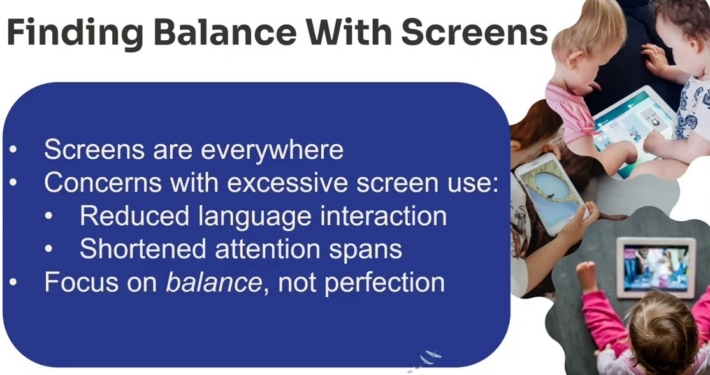
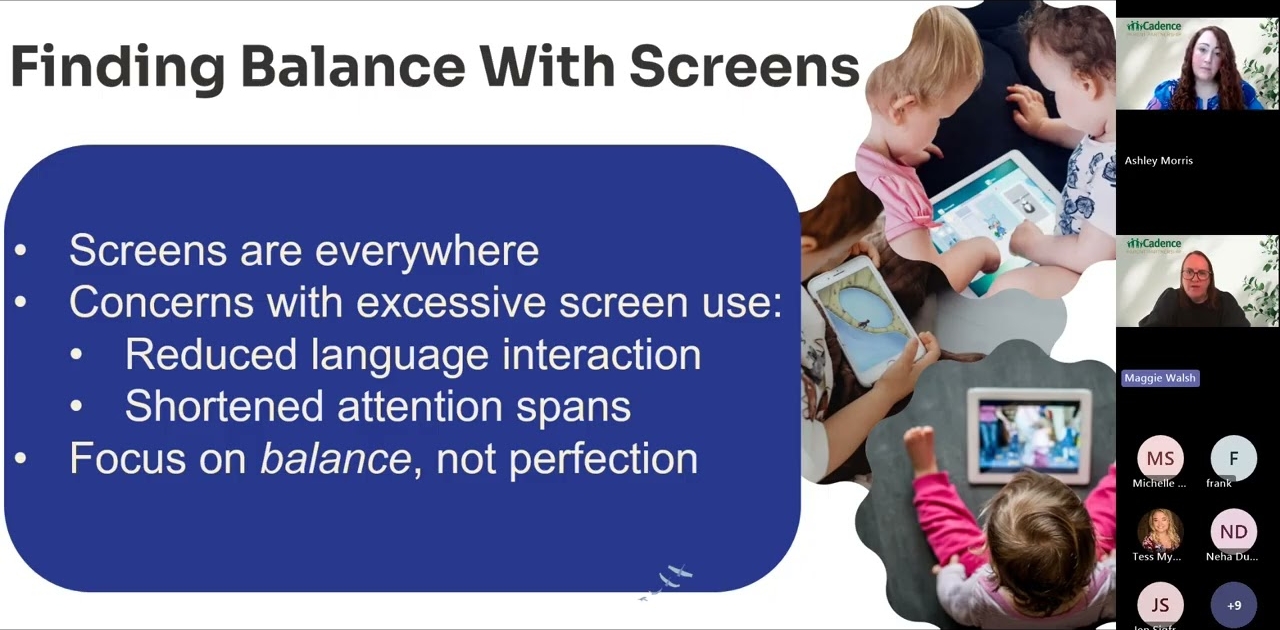
Screens are everywhere today—phones, tablets, TVs, even in places where we least expect them. And it’s important to say this clearly: parents are not failing because screens exist. Families are doing the very best that they can in a busy, high-tech world, often juggling work, home life, and caregiving all at once. Screens can be helpful tools, and for many families, they are part of daily life. Our suggestion to you isn’t to eliminate screens. It is to use them thoughtfully.
That said, there are some real concerns with excessive screen use, especially for young children:
- Reduced Language Interaction: Young children learn language through back and forth conversations—listening, responding, and asking questions, and hearing words used in meaningful ways. When screens take up large amounts of time, they can replace those important interactions with adults and peers. Even high-quality apps can’t fully replace responsive human conversation.
- Shortened Attention Spans: Many screen activities are fast-paced and highly stimulating, which can make it harder for children to engage in slower, deeper activities like listening to a story, building with blocks, or engaging in imaginative play. Children need opportunities to practice focusing, waiting, problem solving, and creating—all skills that develop best through play, conversation, and real world experiences.
Balance, Not Perfection
This is where the idea of balance—not perfection—becomes so important. Balance means being intentional about when and how screens are used without feeling guilty or overwhelmed. It means prioritizing screen-free moments during meals, bedtime routines, reading time, and play times when connection and conversation matter most. It also means being present when screens are used—watching together, talking about what’s happening, and turning screen time into a shared experience whenever possible.
It also means that you’re thinking about your child’s environment. Do you have books thoughtfully displayed and available in multiple rooms in the household? Devices and screens are everywhere. You can help make sure that books are, too.
Balance looks different for every family and that’s okay. Some days will include more screens than others and that doesn’t undo all the positive things that you’re doing. What matters most is that children have plenty of opportunities to talk, play, move, and connect with the people around them. Those experiences are what build strong brains, language skills, and emotional security. By focusing on balance instead of perfection, families can make choices that support healthy development while still living in the real world.
How to Reduce Screen Time Without Power Struggles
Reducing screen time with young children can feel overwhelming, especially when screens are easy, familiar, and often calming in the moment. Many power struggles around screens don’t come from the screen itself, but from how transitions are handled. The good news is that with a few simple strategies, families can reduce screen time without battles, tears, or guilt.
Set Clear and Predictable Limits
The first step is to set clear and predictable limits. Children feel safer and calmer when they know what to expect. Instead of changing the rules day to day, try to be consistent. For example, “Screens are used after dinner but not right before bed,” or “One show and then we turn them off.” When limits are predictable, children don’t feel surprised or tricked and they’re less likely to resist. Calm, confident limits ahead of time are much more effective than negotiating in the moment.
The World Health Organization suggests that 1 hour per day or less for children between the ages of 3 to 5 is a reasonable amount of screen time.
Use Transitions Instead of Abrupt Endings
Another powerful strategy is using transitions rather than abrupt endings. Screens can be very engaging, so turning them off suddenly can feel very upsetting to a child. Giving advanced warnings helps children prepare emotionally. Simple phrases like “One more song,” or “After the show we turn it off,” give them time to adjust. You might even use a visual timer or countdown together. These small transition cues reduce frustration and give children a sense of control, which greatly reduces power struggles.
Choose the Right Screen-Free Replacements
It’s also important to think about what replaces screen time—not just what’s being removed. Screens are often filling a need for entertainment, connection, or calm. So, replacements should meet those needs:
- Read alouds are one of the strongest alternatives. A short story read together provides closeness, language development, and relaxation without overstimulation. Letting children choose the book increases buy-in and can make the transition smoother as well.
- Audio books are another excellent option, especially for children who enjoy listening but aren’t quite ready to sit with a book the whole time. Audio books allow children to imagine, follow stories, and build attention skills without the screen. And they can be used during quiet time, while playing with blocks, or even during car rides. Many children who resist turning off a screen will happily switch to listening instead.
- Play-based activities are one of the most effective screen replacements. Simple materials like blocks, puzzles, dramatic play, and art supplies give children freedom to be creative and active. Even short play invitations like “Let’s build a tower,” or “Want to act out the story we just read?” can redirect attention in a positive way. When play is engaging, children often forget about the screen altogether.
The key to reducing screen time without power struggles is remembering that this isn’t about perfection. It’s about consistency, preparation, and connection. Clear limits, gentle transitions, and appealing alternatives help children feel supported rather than controlled. Over time, these strategies build cooperation, independence, and healthier habits without turning screen time into a daily battle.
Start Small: One Literacy Habit to Try This Week
When it comes to supporting your child’s learning and development, the most powerful changes are often the smallest ones. You don’t need to overhaul your entire routine or do everything that we’ve suggested all at once. Instead, we encourage you to try choosing one habit to start this week—something simple and realistic that fits into your family’s daily life.
Small Habits to Try:
- Reading together before bed, even if it’s only for 5 minutes
- Turning off screens during meals and using that time for conversation instead
- Adding a daily song or rhyme during the car ride, bath time, or getting ready for bed
- Going to your local library once a week—everything there is free, and your child will enjoy getting to pick out whatever they would like
These small repeated moments build connection, language, and routine in powerful ways. What matters most is not doing everything perfectly, but doing something consistently.
Too often, families feel discouraged because life gets busy or routines don’t go exactly as planned. That’s where the idea of progress over perfection becomes so important. Missing a day doesn’t mean you failed. It just means you can try again tomorrow. Children thrive on repetition and predictability. And even tiny habits can add up over time. A short story, a simple song, or a screen-free meal creates opportunities for talking, listening, and connection. These moments support learning and emotional security far more than doing something perfect once in a while.
So, start small, pick one habit, give yourself grace. Over time, those small choices become routines. And those routines become the foundation for your child’s success. Your everyday efforts truly make a difference.
Recommended Resources for Reading Aloud and Finding Books
We wanted to highlight a few resources for you that will help you learn more about reading aloud and finding the right books for your child based on age.
- The Read Aloud Handbook by Jim Trelease — Written quite a while ago, but it provides a lot of great suggestions and advice. You can also find YouTube videos of the author speaking on this topic.
- Literacious — A blog written by a library director who used to be a children’s librarian. She has suggested books by type, genre, and purpose.
- Imagination Soup — Curated by a mother and a former educator. Her blog has book suggestions sorted by topic, age, read aloud, and series. She summarizes most of the books and includes links to locations where you can order them.
- Tonie Box — An audiobook option that costs about $150. You get characters, and playback begins when you place the characters on top of the Tonie Box. It’s a great way for kids to enjoy stories and build language on their own.
We’ll also share some additional articles and resources in our email next week.
If you’ve tried these tips and don’t feel like your child is making progress, partner with your school director to seek additional advice. Our staff works to support every child with their social, emotional, and academic goals. And your child’s teacher is probably encouraging a love of literacy at school already and will have some helpful tips to share with you.
Q&A: Your Top Questions About Early Literacy Answered
My child only wants the same four books at bedtime. How do I help her try new ones?
Rereading the same books gives children comfort, predictability, and a sense of mastery. As adults, it can be very hard to muster up excitement for reading and rereading the same books over and over again. But for your children, rereading the same books gives children comfort, predictability, and a sense of mastery. What’s happening right now is your child is using familiar stories to wind down. They enjoy knowing the words and pictures, which is an early literacy skill, and they’re seeking comfort and control at the end of the day.
The goal here is not to take away the favorites, but to build flexibility around them. Here are a few strategies to consider:
- The old plus the new rule. Reread a favorite and add one new book. You can say, “We’re either going to start with a new one tonight or we’re going to end with a new one—you pick.”
- Rotate the favorites. Instead of reading all four every night, put two on rotation: “Tonight, these are our two bedtime books. The other two will be back tomorrow.”
- Introduce new books during the day. Point out concepts that will relate to your child: “Hey, this is a great bedtime story. I thought we’d just read it now for fun,” or “You might like this book—it’s silly, just like the one we read at night.”
- Create a visual schedule for bedtime book choice that allows your child to pick two favorites and one new book each night.
This shift might take some time. Don’t expect that if you try this out tonight that everything will go perfectly. It takes a little bit of time to build new routines.
How do I keep my toddler engaged during reading time when they keep running around or refusing to sit?
First, let me say that you’re not doing anything wrong. This is a very typical toddler behavior. For many toddlers, listening to a book while sitting still is very hard and harder than it looks. Engagement at this age can be kind of messy or wiggly and normally brief.
A toddler can still be engaged without sitting right next to you or listening to every word or even staying tuned into the end of the book. Engagement might look like:
- Walking around while they’re listening
- Coming over to look at one page, turning a page, pointing, or naming a couple of pictures
- Finishing phrases and then sitting with you for 30 seconds, then leaving, then coming back
Here are a few strategies that meet toddlers where they are developmentally:
- Try high interaction books. These invite participation through lift-the-flap pages, touch-and-feel elements, repetitive or predictable phrases, and short books with bold pictures.
- Skip long paragraphs if you need to. They can’t read at two or three, so they’re not going to know that you’re skipping words. It’s okay to just talk about the pictures instead of reading every word.
- Keep it short and end before they melt down. Read one book instead of five. Even a few pages count. Quit while it’s still positive—this helps your toddler associate reading with success, not struggle.
- Use your voice, face, and body. Your energy matters. Try silly voices, facial expressions, sound effects, or dramatic pauses. You don’t need to perform, but a little animation goes a long way.
How do I help my child transition from knowing letters to sounding out words or learning sight words?
This is an important time in early literacy. The key is understanding that children don’t jump directly from knowing letters into just reading words. There are several developmental steps in between. Children tend to move through these phases:
- Letter knowledge
- Letter sounds
- Blending sounds
- Recognizing words
Both sounding out words (phonics) and learning words by sight matter. In general, before reading words, children usually need to recognize letters and know what sound each letter makes.
If you notice that your child is recognizing letter names, you can start to reinforce sounds with them while reading. Point to the beginning of words they see a lot—words like mom, love, want, see, happy—and ask them what sound the first letter makes. Your child may not know, which is totally fine. You’ll reinforce this by telling them the sound and asking them to repeat after you. Try this for maybe four or five words while reading a book—about one word every couple of pages.
Then, be on the lookout for words that start or end with the same sound, like rhyming words. You can point out when words sound the same at the beginning or the end. Again, you only need to do this one or two times while reading a book. When your child has learned their short vowel sounds, then you can encourage them to begin sounding out each letter in the word—words like cat, dad, or mom. Long vowel words come later.
Finally, there are definitely many words that have to be learned by sight because they have parts that do not follow the standard rules. Some examples include the, was, love, they, and, said. When you come across a word like that, it’s good to just tell your child the word and have them repeat it.
Definitely work with your child’s teacher to find out where your child is developmentally. And don’t stress too much about doing it wrong—any support here is great. And most importantly, keep reading for fun. Don’t worry all the time about needing to support them with decoding even when you know they’re working on those skills at school. Reading for fun is where it’s at.
Closing
Thank you so much for joining us. This session marks the end of our parent webinars until the new school year. We hope that you’ll join us again next fall when we’ll begin again. Expect some new topics and a revisiting of some popular hot topics. Thanks so much for your time today.