
Webinar length: 31:39
Presenters:
- Maggie Walsh (VP of Education, Cadence Education)
- Ashley Morris (Executive Director of Montessori Schools)
Introduction of Creative Ways to Encourage Healthy Eating
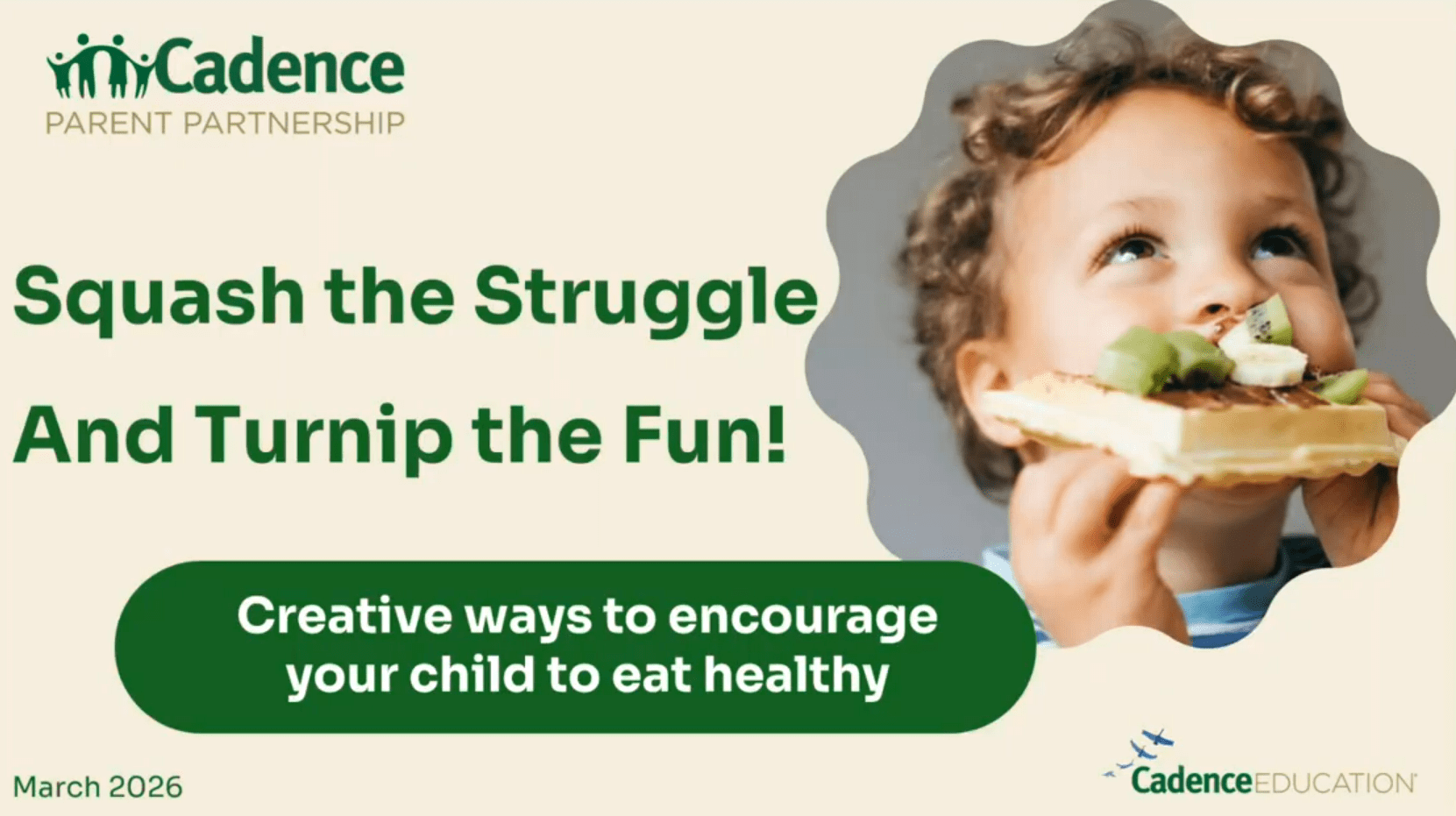
Hello everyone, and thank you for being here today. Welcome to our March Cadence Education parent partnership conversation, Squash the Struggle and Turn Up the Fun, which is just basically a fun way to say that we’re going to have a conversation about creative ways to encourage your child to create some healthy eating habits. It’s a full conversation, and we’re so grateful for you here today.
At Cadence Education, it’s really important to us to foster communication and partnership with our families and parents. With over 300 schools and over 30 years of experience, also our promise is important to us, which is to provide peace of mind while providing children an exceptional education every fun-filled day. That drives essentially all that we do. This includes our food for thought nutrition and menu program, as well as our kids cafe program, which is essentially a cooking class for children that connects them to preparing and tasting foods.
Today, our conversation is also led and inspired by some great resources, recommendations, and best practices shared by the USDA Child and Adult Care Food Program, pediatricians, as well as the Cleveland Clinic, and more. We’re also going to share some highlights, pictures, and things that we have learned from the children themselves in our kids cafe. So, let’s get started.
Meet the Presenters
As we start our conversation today, we want to start by introducing ourselves.
My name is Shelley King, and I’m the senior director of classroom experience here at Cadence. With over 35 years of experience in early childhood and early childhood leadership, I’ve also enjoyed the opportunity that I’ve had to study early childhood nutrition and work with our schools that operate the USDA child and adult care food programs.
With me here today is Ashley Morris.
Hi everyone. I’m Ashley Morris. I’m executive director of Montessori schools. I bring 22 years of experience in early childhood and teacher leadership. Thank you so much for joining us today.
Webinar Objectives
Our discussion today has three simple objectives that we hope you’ll find useful as you strive to help your child build some lifelong habits when it relates to being healthy, and specifically with food. Getting started with some sound practices can make a big difference. But we will also talk about what to recognize when there’s food resistance and some ways to help your child overcome them. And we will also talk about how you can foster mealtimes that build healthy habits for the whole family.
Healthy eating habits really do begin in the early years, and you are the most impactful person for your child in these formative years. Today’s conversation is packed with some wonderful approaches to help your child begin their journey to healthy eating habits and a healthy attitude with food.
Course 1: Making Mealtimes Matter
Infant Nutrition and Early Feeding
As we begin the first course, let’s start with our very young eaters. It’s important to note that the key nutrition for infants birth to 12 months come from breast milk or nutrient-rich formula. These have antibodies, hormones, and enzymes in breast milk. And both breast milk and formula contain a key balance of nutrition with proteins, carbohydrates, fat, and calcium, as well as DHA and vitamins and minerals.
These provide all the infant’s needs for their incredible development happening in their first year of life. When a child reaches about 4 months, we can begin to partner with our pediatrician for the right approach and begin what we’re going to refer to as complementary foods or solid foods.
Introducing New Foods
Your pediatrician may recommend starting with rice or oat cereal and then beginning to blend in fruits and vegetables. As you introduce these complementary foods, you want to introduce them in some sort of rotation to leave space in between to observe if your child has an intolerance or possible allergy.
Being present and modeling while you yourself eat and you also feed your child can set a great precedence for what mealtime is meant to be.
Often, it takes several times, up to 8 to 12 times of introduction, before your child may actually determine if they like the taste or texture of a new food. Allowing your child to touch, taste, smell may help with familiarity for later consuming.
Toddlers and Mealtime Development
Thank you, Ashley. So, let’s talk a little bit about some of my favorite people, toddlers. And young toddlers are in such an exploratory phase, and that is the same when it comes to their growing independence and understanding of feeding themselves.
Continue to offer a variety. Again, lots of different tastes, textures, and colors by giving them also opportunity to be more hands-on. This can be with utensils, starting simple with spoons and sporks, and later on adding, but also their independence to do a little bit of serving themselves.
Be patient and expect messes. They’re learning, so it’s going to happen.
Mealtime Best Practices
As we start to think about our first course, which is making mealtime matter, here are some great best practices that relate to that.
First, consistent mealtimes and patterns. The USDA Child and Adult Care Food Program offers tools that help guide meal timing and structure.
It starts with a healthy breakfast, one that is high in protein, carbohydrates, and fats, and low in sugar. Healthy snacks in healthy portions are important as well.
Mealtime rituals can be fun and help build consistency. Another thing to avoid doing is forcing your child to clear their plate.
Course 2: Helping Hands in the Kitchen
Meal times can be very busy and challenging. It can be tempting to have your child do an alternate activity away from the kitchen.
But as you consider inviting them into the kitchen, even with simple tasks, you’re teaching your child healthy habits of preparing meals. Children are more likely to taste and try foods they help prepare, plan for, select, and even grow.
Involving Your Child
What does this look like at home or at school?
You could consider starting a small herb garden or letting your child help select items at the grocery store. You can invite your child to help set the table, prepare fruits and vegetables, and clean up after meals.
During mealtime, you can talk about the food, where it came from, and how it was prepared.
As Maria Montessori said, “What the hand does, the mind remembers.”
Course 3: Healthy Habits in Action
To help children build healthy habits related to food, we want to have hands-on experiences. These help make important connections for children.
Reading books and sharing food stories is also a great way to inspire children to eat healthy foods.
Eating the Rainbow
Children love rainbows, and eating the rainbow means consuming fruits and vegetables in a variety of colors that provide essential nutrients.
As you practice eating a variety of bright-colored foods, you’re setting the standard.
Everyday Healthy Habits
Another habit is to drink plenty of water. Start the day with a healthy breakfast and take time to enjoy meals.
Children are watching and learning from you, even when you don’t think they are.
Q&A Highlight
Encouraging Mealtime Engagement
So, the first question is, how can I encourage my child to sit at the table and eat, and how do I get them to eat the food we give them versus throwing it on the ground?
Start with limiting the amount of food on their plate. Introduce utensils to create engagement. Model sitting and eating together.
Create rituals like songs or conversations and involve your child in cleanup after meals.
Closing
We want to remind you that this is a journey. Start small, mix in some basic things to your current routine, and build from there.
We will send a follow-up email with the recording, resources, and Q&A.
Thank you so much for your time today.