


Motor development is one of the most important parts of early learning because children learn with their whole bodies. When toddlers, preschoolers, and pre K learners grasp tiny objects, pour water, paint, jump, climb, balance, and move through space, they are doing far more than burning energy. They are building strength, coordination, focus, body control, and confidence in what their bodies can do.
Fine motor skills involve the small muscles in the hands and fingers that children need for writing, drawing, using utensils, zipping and buttoning, cutting with scissors, building with blocks, and manipulating small objects. Gross motor skills involve the larger muscles used for running, hanging, climbing, throwing, hopping, balancing, and navigating the playground. Both are essential for school readiness, self help skills, and independence in daily routines.
When children move, explore materials, and practice using their bodies in new ways, they not only grow stronger physically but also develop focus, perseverance, problem solving, and pride in their accomplishments. The playful activities below support both fine and gross motor development using simple materials and hands on learning children love.
Fine Motor Skill Activities for Preschoolers
(Strengthening hands, coordination, and pre-writing skills)
Fine motor activities strengthen the small muscles in children’s hands, helping them grasp tools, write, draw, manipulate objects, and build independence in everyday tasks.
3D Art Sculpture
This hands-on building project strengthens hand muscles as children twist, attach, squeeze, and arrange materials to form their own sculpture. Creativity and problem-solving grow as they decide what to build and how to construct it.
Steps
- Give your child a Styrofoam base.
- Offer a variety of building materials.
- Encourage designing and experimenting.
- Ask them to describe what they created.
Materials
Construction paper strips, glue, tape, staples, pipe cleaners, Styrofoam, paper, pencils, markers, pom-poms, beads, assorted household materials
Age-Appropriate Adaptations
- Two-year-olds — Fewer, easier-to-use materials such as pipe cleaners and Styrofoam only.
- Three-year-olds — Name the colors used in the sculpture.
- Four-/Five-year-olds — Draw a picture of the finished sculpture.
Skills Supported
Aesthetic appreciation, creativity, fine motor development, tool usage
Book Making Activity: Make It. Write It. Read It.
Creating homemade books allows children to be authors and illustrators while practicing storytelling, drawing, and page turning — all of which strengthen fine-motor control and expressive language.
Steps
- Provide examples of different book types.
- Explain tools and construction methods.
- Invite your child to draw pictures on each page.
- Write their dictated ideas under the drawings.
- Celebrate the finished book by reading it together.
Materials
Colored paper, markers, scissors, glue
Age-Appropriate Adaptations
- Two-year-olds — Provide a pre-constructed blank book for children to complete.
- Three-year-olds — Choose a book style and label characters.
- Four-/Five-year-olds — Create themed shapes and storylines independently.
Skills Supported
Language development, fine motor skills, critical thinking, appreciation of the arts
Creative Expressions Activity: Look What I Can Make
Drawing freely gives children the opportunity to express ideas, explore creativity, strengthen grip and hand muscles, and practice pre-writing strokes that support handwriting later on.
Steps
- Offer drawing tools like crayons, pencils, or markers.
- Encourage your child to draw freely.
- Ask open-ended questions about the picture.
- Display or save artwork to build confidence.
Age-Appropriate Adaptations
- Two-year-olds — Draw from observation (mirror, window, photo) and talk about the picture.
- Three-year-olds — Create basic designs and answer detailed questions about drawings.
- Four-/Five-year-olds — Add details and tell stories using their artwork.
Skills Supported
Fine motor (drawing/painting), storytelling, answering questions, creativity
Marshmallow Painting
Painting with marshmallows encourages sensory exploration while strengthening finger and hand control. Stamping patterns and shapes helps children practice early symbol recognition in a playful way.
Steps
- Dip marshmallows in paint.
- Stamp onto paper to create images or patterns.
- Count or describe the marks made.
- Display artwork or use it during pretend play.
Materials
Marshmallows, paper, easel, paint
Age-Appropriate Adaptations
- Two-year-olds — Hold marshmallows with a spoon or fork; look at camping books/photos while painting.
- Three-year-olds — Place marshmallows on sticks; count dots and tell a story about camping.
- Four-/Five-year-olds — Paint letters, numbers, or imaginary maps for a pretend camping trip.
Skills Supported
Fine motor strength, sensory exploration, number recognition, storytelling
Messy Spelling Activity: Shaving Cream Spelling
Writing letters in shaving cream builds sensory awareness, strengthens finger muscles, and makes spelling feel fun and pressure-free.
Steps
- Spread shaving cream across a flat surface.
- Form letters or words with fingers.
- Say each letter or word out loud.
- Smooth the shaving cream to start again.
Age-Appropriate Adaptations
- Two-year-olds — Form the first letter of their name.
- Three-year-olds — Practice writing all letters of their name using a model to reference.
- Four-/Five-year-olds — Spell first name independently, then last name when ready.
Skills Supported
Language and vocabulary, fine motor development, sensory learning, handwriting preparation
Sorting 2D & 3D Objects by Shape
Sorting strengthens finger coordination and teaches children to examine shapes, sizes, and spatial characteristics closely — an early foundation for math and problem-solving.
Steps
- Gather 2D and 3D objects.
- Sort into baskets or piles by shape.
- Name shapes and compare similarities.
- Hunt for new household items that fit each category.
Materials
2D & 3D objects, baskets or boxes
Age-Appropriate Adaptations
- Two-year-olds — Sort 2–3 shapes using picture labels on baskets.
- Three-year-olds — Sort 4–5 shapes using picture + word labels.
- Four-/Five-year-olds — Sort 5–7 shapes and find additional items around the home.
Skills Supported
Shape recognition, size comparison, orientation awareness, fine motor coordination
Gross Motor Activities for Preschoolers
(Movement, balance, strength, and coordination)
Gross motor play strengthens the whole body, helping children build balance, strength, coordination, spatial awareness, confidence, and self-regulation.
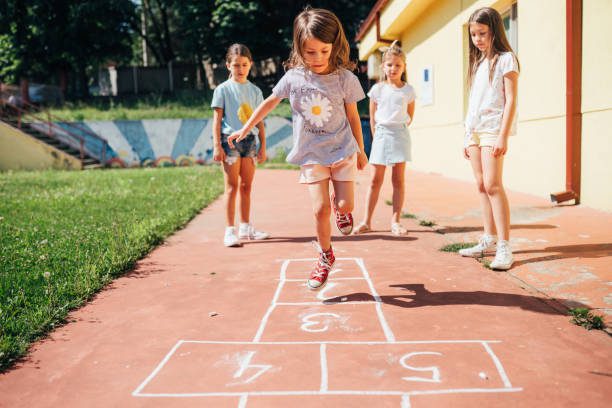
Gymnastic Obstacle Course
Obstacle courses help children crawl, jump, spin, climb, and balance while following a sequence. Designing and completing the course builds physical strength as well as problem-solving and self-confidence.
Steps
- Set up stations for crawling, weaving, climbing, and jumping.
- Demonstrate or walk through the course together.
- Run through the course at a comfortable pace.
- Celebrate finishing and repeat if desired.
Materials
Chalk, chairs, pop-up tunnel, household items
Age-Appropriate Adaptations
- Two-year-olds — Demonstrate the course first; play with a familiar song like Head, Shoulders, Knees, and Toes.
- Three-year-olds — Have children describe what they want in the course and help design it.
- Four-/Five-year-olds — Children build the full course themselves and race with an adult.
Skills Supported
Crawling, running, spinning, coordination, STEM (structure design), confidence
Practice Your Balance: Balancing to Music
Music paired with movement improves balance, rhythm, and concentration. Walking along a taped line while responding to tempo changes helps children control their bodies and move safely in space.
Steps
- Set up a balance beam or tape line.
- Play music and walk along the line.
- Match movements to slow and fast tempos.
- Try balancing on one foot or turning while staying on the line.
Materials
Music source, balance beam or taped/chalked straight line
Age-Appropriate Adaptations
- Two-year-olds — Hold a hand, wall, or shelf while balancing.
- Three-year-olds — March or step to match fast/slow tempos without holding support.
- Four-/Five-year-olds — Create their own taped beam (zig-zag, shapes, jumps, letters) and balance using different call-outs (one foot, jump, turn).
Skills Supported
Balance, coordination, motor control, listening, rhythm
Musical Freeze Shapes: Stop When I Say Freeze
Combining energetic play with academic recognition helps children strengthen impulse control, memory, and physical motor planning as they freeze on shapes, numbers, or letters.
Steps
- Draw shapes, numbers, or letters on the sidewalk.
- Move between drawings while music plays.
- Freeze when the music stops.
- Identify the shape, number, or letter you landed on.
Age-Appropriate Adaptations
- Two-year-olds — Jump from shape to shape while naming shapes/colors.
- Three-year-olds — Move in different ways and freeze on a drawing to identify it.
- Four-/Five-year-olds — Include more advanced shapes like pyramids or cubes and larger numbers.
Skills Supported
Gross motor development, balance, number/letter/shape recognition, following multistep directions
Royalty Hopscotch: Let’s Get Hopping
A fairy-tale-themed hopscotch game adds pretend play to physical learning, motivating children to move longer while strengthening balance, coordination, and counting.
Steps
- Draw themed hopscotch squares like tiara, castle, or music notes.
- Toss a pebble and hop through the sequence.
- Count squares and cheer for progress.
- Switch roles and take turns.
Materials
Sidewalk chalk
Age-Appropriate Adaptations
- Two-year-olds — Use numbers 1–5 or a few shapes; assist counting and hopping.
- Three-year-olds — Children draw the hopscotch themselves and test different jumping styles.
- Four-/Five-year-olds — Add more squares or turn the hopscotch into a full obstacle course.
Skills Supported
Jumping, hopping, counting, creativity, imagination, fine motor (chalk control), hand-eye coordination
Looking for more activities?
There is so much more to explore. Children learn best when they can move, build, create, problem-solve, and express themselves across every developmental area.
→ Explore more activities for kids.
Why Motor Development Matters for Toddlers, Preschoolers, and Pre K Learners
Motor development plays a powerful role in school readiness and lifelong learning. When young children build strength, balance, coordination, and body awareness through movement and hands on play, they gain confidence in their abilities and the independence needed for everyday tasks.
• Strong fine motor skills prepare children for writing, drawing, using tools, self care, and academic tasks.
Activities that strengthen the small muscles of the hands and fingers support handwriting, using utensils, zipping and buttoning, drawing, cutting, and manipulating objects (Continued.com)
• Gross motor development supports physical health, stamina, and emotional regulation.
Running, balancing, climbing, and jumping help children build strength and core stability while also improving body control, spatial awareness, and self regulation (Oregon State).
• Motor development connects directly to cognitive and language growth.
Research shows that physical play supports planning, sequencing, focus, memory, and expressive vocabulary as children talk about what they are doing, solve challenges, and learn new skills through movement (nih.gov)
• Confidence in the body builds confidence in learning.
When children feel capable physically, they are more willing to try new challenges, take safe risks, make decisions, and approach learning with a growth mindset (Oregon State).
How Can Families Incorporate Motor Skills in Everyday Life?
Everyday play activities like climbing at the playground, drawing with crayons, scooping sand, threading beads, dancing to music, and hopping between pillows help children build strength and coordination while having fun.
Movement based play encourages children to focus, follow directions, problem solve, and express emotions in healthy ways. Children begin to understand what their bodies can do and take pride in learning new skills.
With simple daily routines, families can support:
✔ strength and muscle control
✔ focus and persistence during tasks
✔ independence in self care and school routines
✔ confidence in both physical and academic learning
Every playful moment that involves moving, grasping, jumping, lifting, balancing, climbing, or creating supports a child’s development across multiple learning areas.
Daily Movement and Learning with Cadence Education
Movement is a core part of learning at Cadence Education. Our classrooms and playgrounds give children space to climb, build, paint, run, create, and explore so they can grow strong bodies, strong minds, and strong confidence. We support motor development through hands on play because children learn best when they can move, experiment, and use their whole body.
We would love to meet your family and learn more about your child’s interests, strengths, and learning style.
→ Find a Cadence school near you and schedule a tour