
Tag Archive for: Pre-K

Getting ready for kindergarten is a big milestone — for your child and for you. It’s natural to wonder: Is my child ready? What should they know before walking into that classroom?

The truth is, readiness isn’t only about letters and numbers.

It’s also about confidence, independence, and social-emotional growth. In fact, new research reveals 82% of parents agree children entering kindergarten with confidence is just as important as reciting the alphabet.

At Cadence Education, we’ve seen firsthand how children thrive when they’re supported in every area of development — not just academics.

👉 Find a Cadence Academy Preschool near you.

Why Families Choose Cadence

At Cadence Education, we serve families across the country with programs designed to balance academics and social-emotional growth. Parents choose us because we offer:

  • Experienced teachers who model positive behaviors
  • A curriculum that blends learning with play
  • A nurturing environment where children feel safe
  • Proven results in preparing children for kindergarten

With our Kind Child® program and research-backed curriculum, your child won’t just be ready for kindergarten — they’ll be excited for it.

How Cadence Kids Are Growing

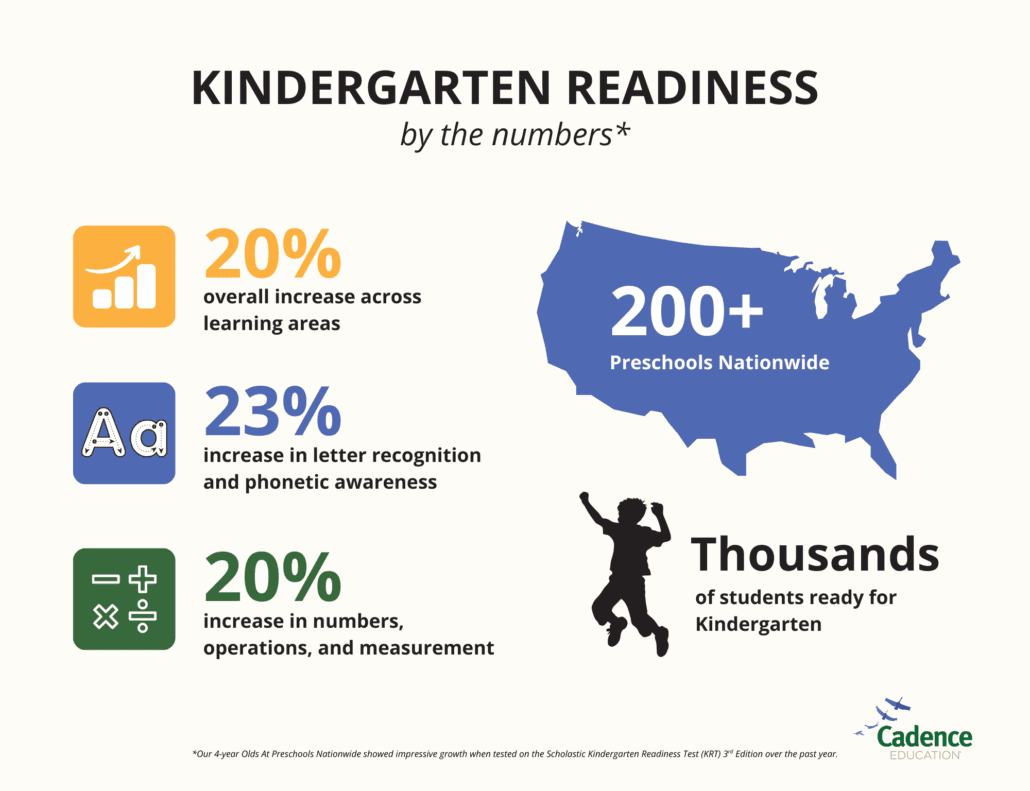
Over the past school year, our preschool 4-year-olds showed impressive growth on the Scholastic Kindergarten Readiness Test (KRT), 3rd Edition:

  • 20% increase across all learning domains
  • 23% increase in letter recognition and phonemic awareness
  • 20% increase in numbers, operations, and measurement

These results confirm what we already believe: academic growth comes naturally when social and emotional needs are met first.
How We Measure Progress

We use the Scholastic Kindergarten Readiness Test (KRT), 3rd Edition to see how children are doing across all areas of development. This includes:

  • Literacy and phonemic awareness
  • Number sense and early math skills
  • Problem-solving
  • Following directions and routines

The data shows what we already see in our classrooms every day — Cadence kids are thriving.

We’re also surveying our own Cadence families so we can continue to set benchmarks, measure progress, and ensure we’re preparing every child for success.

Why Kindergarten Readiness Is More Than Academics

Parents everywhere are rethinking what it means to be “ready” for kindergarten. Yes, children need early reading, writing, and math skills. But families today also want schools to nurture things like:

  • Creativity and imagination
  • Emotional intelligence
  • Social development and friendships
  • Confidence and resilience

Experts agree — these “soft skills” are just as important as academic skills. They help children build relationships, solve problems, and feel confident enough to tackle challenges.

That’s why all Cadence Education schools take a whole-child approach. We want your child to start kindergarten not just ready to learn, but excited to learn.

What Parents Tell Us Matters Most

We hear from parents every day: you want a school that will prepare your child academically, but you also want a place where they’ll feel safe, loved, and supported. That’s where our Kind Child® program makes a difference.

Through Kind Child, our teachers model and encourage qualities like friendship, thankfulness, positive self-image, and responsibility. Children get daily opportunities to practice these skills in real-life classroom situations.

The result?

Confident, capable kids who know how to treat others kindly while taking pride in their own growth.

Kindergarten Ready Checklist

You may be wondering what readiness looks like in everyday life. Readiness is about confidence and progress– not perfection.

Remember, no child is expected to do all of these perfectly. Every child develops at their own pace. Your role as a parent — and ours as educators — is to guide and support them as they grow. The best advice we have is to read and talk with your children as much as possible. Introduce your child to a wide variety of words and real-life experiences.

Here are some signs your child is on the right track:

General Information Kindergarten-Ready Children Should Know:

  • First and Last Name
  • “I go to [School Name]”
  • Age/Birthday

Cognitive and Academic Skills:

  • Recognizes at least 15 uppercase letters, numbers 1-10, and 5-7 shapes
  • Colors – Red, Yellow, Blue, Green, Orange, Purple
  • Can write most or all of their first name
  • How to count to 20
  • Can follow directions with at least 2 steps
  • Understands the meaning behind prepositions such as: in, out, before, behind, under, on top of, on, up, down

Language and Communication Skills:

  • Speaks in complete sentences
  • Listens to and retells simple stories
  • Can ask questions and share ideas
  • Joins group conversations and activities

Social and Emotional Development:

  • Plays cooperatively with other children
  • Can take turns playing with another child
  • Able to share even if they are not always willing to do so
  • Can sit down next to an adult and listen to a story
  • Can play with a toy alone for at least 7 minutes
  • Manages emotions with occasional support
  • Shows empathy and builds friendships

Independence and Self-Help Skills:

  • Uses the bathroom independently, including wiping themselves and pulling up underpants and straightening out clothing
  • Can wash hands and dress with independence
  • Button, snap, and/or zip clothing
  • Knows how to put things in their backpack, put their lunch away, and put their items in a cubby
  • Is willing to try new tasks with growing confidence

Let’s Get Ready Together

If you’re asking yourself, Is my child ready for kindergarten?, know that you’re not alone. Every parent wonders the same thing. At Cadence, we’re here to reassure you, guide you, and celebrate your child’s growth every step of the way.

We’d love to show you how our programs prepare children for kindergarten success — and how your child can thrive here, too.

👉 Find a Cadence Academy Preschool near you.

Sending your child off to kindergarten can be a big milestone that not every kid is ready for. It can be difficult to determine whether your child is prepared for the next step in their education, especially since full-time kindergarten is often a big change from their current everyday schedule. 

Here are some signs to look for when determining if your child is ready for kindergarten and how to help them prepare.

Signs Your Child Is Not Ready for Kindergarten

There is nothing wrong with taking longer to enter kindergarten or preparing more for the transition. You want your child to be in the best place to succeed. Here are some potential setbacks to look out for and assist your child with. 

Limited Vocabulary

In kindergarten, children will be expected to communicate their needs, wants, and feelings to their teachers and classmates. If your child has a limited vocabulary or struggles to express themselves verbally, they may not be ready for the social and academic demands of kindergarten.

Many children have limited vocabulary or communicate partially through mixed English and rudimentary sign language. In order to function in kindergarten, there are some general categories that a child should be able to converse in. These include:

  • Physical needs (like bathroom breaks)
  • Safety issues (like a suspicious situation/unsafe moment)
  • Basic child-level conversational skills (like chatting with playmates)
  • Ask and answer capabilities (like responding to teacher questions, yes and no responses)

While your child will need more vocabulary than this to truly succeed, these are the main categories to begin focusing on. 

Poor Social Skills

Kindergarten is a time for children to develop social skills and learn how to interact with their peers. If your child struggles with sharing, taking turns, or making friends, they may not be ready for kindergarten. These skills may not be perfected when entering elementary school. Part of the schooling experience is learning how to better interact with others.

However, encouraging your child to share, being comfortable losing games, and learning to share attention with other students is key. Remember, social skills are just as important as academic skills, and children who lack them may also struggle in the classroom.

Difficulty Following Directions

Kindergarten teachers will give directions for a variety of activities throughout the day. If your child has difficulty following instructions or staying on task, they may not be ready for the structure and routine of kindergarten.

It can endanger your child and other students if they’re incapable of following directions. Teaching children to follow directions like stop, no, walk with me, etc., can make a huge difference in the safety and efficiency of a classroom.  

Poor Motor Skills

Kindergarten is a time for children to develop gross and fine motor skills, such as running, jumping, cutting with scissors, and writing. If your child struggles with all of these activities or completely lacks coordination, they may not be ready for the physical demands of kindergarten.

Most children want to play and craft, so these skills are easy to practice and improve upon! 

Lack of Independence

Early elementary is a time for children to develop independence and self-sufficiency. If your child relies heavily on you or other adults to do things for them, they may not be ready for the level of independence required in kindergarten.

Developing healthy attachment with your child can be hard, especially coming off of the COVID-19 pandemic. Practice leaving your child with trusted adults and in new situations, using positive reinforcement to show that separation isn’t permanent (and can be fun). 

Best Types of Daycares for Getting Children Ready for Elementary School

If you’re concerned that your child may not be ready for kindergarten, there are several types of daycares that can help prepare them for this big step in their lives.

Preschool Programs

These programs are designed for children ages three to five and can help prepare them for kindergarten. These programs typically focus on developing social skills, language and literacy skills, and fine motor skills. 

Preschool programs can range wildly in the level of care and focus; however, most are general care facilities. 

Montessori Programs

Montessori programs are based on the educational philosophy of Maria Montessori and are designed to foster independence, creativity, and critical thinking. These programs often incorporate hands-on learning activities and encourage children to work at their own pace.

Reggio Emilia Programs

Reggio Emilia programs are based on the educational philosophy developed in the town of Reggio Emilia, Italy. These programs focus on inquiry-based learning and encourage children to explore their interests and curiosities. Reggio Emilia programs often incorporate art and nature into their curriculum.

Cadence Education: Preparing Children for Kindergarten 

If you’re concerned that your child may not be ready for kindergarten, it’s important to take action. Consider enrolling them in a program that can truly help prepare them for elementary school. 

Cadence Education provides high-quality daycare and preschool programs that focus on holistic child development. Our curriculum is designed to help children develop the social, emotional, cognitive, and physical skills they need to succeed in kindergarten and beyond. Contact us today to learn more about our programs and how we can help prepare your child for the next step in their education.

As parents, educators, and caregivers, it’s natural to be curious about a child’s development, especially when it comes to identifying giftedness. Gifted children often display unique characteristics that set them apart from their peers, and recognizing these traits early on can pave the way for tailored educational experiences. 

Here’s a comprehensive checklist to help you identify a gifted 5-year-old, covering various aspects of their intellectual, academic, creative, and social abilities. 

General Intellectual Capability

Does your child check off any of the following traits regarding their general intellectual ability? 

  • Curiosity Beyond Age Level: Gifted children often exhibit an insatiable curiosity that goes beyond what is typical for their age group. They may ask complex questions or show a keen interest in a wide range of subjects.
  • Rapid Learning: Pay attention to a child’s ability to grasp new concepts quickly. Gifted 5-year-olds may demonstrate accelerated learning in areas like reading, math, or general knowledge.
  • Advanced Vocabulary: Gifted children tend to have an extensive vocabulary for their age. Look for the use of complex words and the ability to express thoughts with clarity.

Academic Aptitude

Does your child check off any of the following traits regarding their academic aptitude? 

  • Reading Proficiency: Gifted preschoolers may show an early interest in reading and demonstrate reading skills beyond their age group. They may enjoy more advanced books and comprehend complex ideas.
  • Mathematical Prowess: A gifted 5-year-old might display an innate aptitude for mathematics. This can include an understanding of basic mathematical concepts and the ability to solve problems beyond the typical kindergarten level.
  • Love for Learning: Gifted children often display a genuine love for learning. They may independently seek out information and engage in activities that stimulate their intellectual curiosity.

Creative Thinking

Does your child check off any of the following traits regarding their creative thinking skills? 

  • Imaginative Play: Gifted preschoolers often engage in imaginative play beyond the ordinary. Look for signs of elaborate storytelling, creative scenarios, and the ability to think outside the box.Problem-Solving Skills: Gifted children may demonstrate advanced problem-solving skills. They may approach challenges with unique perspectives and devise creative solutions.
  • uncheckedInterest in Artistic Expression: Keep an eye on a child’s interest in artistic activities. Gifted 5-year-olds might have a natural inclination toward drawing, painting, or other forms of artistic expression.

Leadership Ability

Does your child check off any of the following traits regarding their leadership ability? 

  • Natural Leadership: Gifted children may naturally take on leadership roles in group activities. They may exhibit strong organizational skills and an ability to influence their peers positively.
  • Effective Communication: Look for effective communication skills, both verbal and non-verbal. Gifted 5-year-olds may express themselves with confidence and clarity.
  • Cooperative Play: Gifted children often demonstrate an understanding of teamwork and collaboration. They may excel in group activities and show an ability to work well with others. 

Psychomotor Ability

Does your child check off any of the following traits regarding their psychomotor ability?

  • Fine and Gross Motor Skills: Gifted preschoolers may have advanced fine and gross motor skills. This can include precise hand-eye coordination, balance, and agility.
  • Early Interest in Sports: Keep an eye on a child’s interest in sports and physical activities. Gifted 5-year-olds might display exceptional athletic abilities or a keen interest in trying various sports.

Visual and Performing Arts Skills

Does your child check off any of the following traits regarding their visual and performing arts skills? 

  • Musical Talent: Gifted children may show an early interest and talent in music. This can manifest through an ability to sing in tune, play musical instruments, or show a strong rhythmic sense.
  • Visual Arts Aptitude: Look for signs of artistic talent in drawing, painting, or sculpting. Gifted 5-year-olds may express themselves creatively through visual arts.


Traits of a Gifted Child

The intensity, keen observation, and sophisticated sense of humor in gifted 5-year-olds showcase not only their advanced cognitive abilities but also their unique way of engaging with the world. These traits provide a glimpse into the rich inner world of a gifted child and highlight the importance of recognizing and nurturing their exceptional qualities from an early age. Read on to discover more. 

Intensity

Gifted children exhibit a level of intensity that sets them apart in their pursuits. This intensity goes beyond mere interest; it’s a profound, almost all-encompassing passion for the subjects or activities that capture their curiosity. When a gifted 5-year-old finds something they are passionate about, whether it’s dinosaurs, outer space, or building intricate structures with blocks, their focus becomes laser-sharp. 

They immerse themselves wholeheartedly, often losing track of time as they delve into the intricacies of their chosen passion. This heightened intensity can manifest as an insatiable desire to explore, learn, and create within their areas of interest.

Keen Observation

A remarkable trait of gifted 5-year-olds is their exceptional ability to observe and pick up on details that others might easily overlook. Whether exploring nature, playing with toys, or engaging in everyday activities, gifted children possess an acute awareness of their surroundings. They notice the subtleties — the patterns, colors, and shapes — that might escape the attention of their peers. 

This keen observation is indicative of their heightened cognitive abilities and a natural inclination towards analytical thinking. 

Sense of Humor

A sophisticated sense of humor is another distinctive trait often found in gifted children. Gifted 5-year-olds may surprise adults with their wit and capacity for understanding humor that extends beyond their years. This goes beyond simple giggles; gifted children may appreciate wordplay, clever jokes, and humor rooted in a nuanced understanding of language. 

Their ability to grasp and appreciate subtle nuances in humor demonstrates an advanced cognitive grasp of linguistic concepts. Whether it’s a play on words, clever puns, or a quick understanding of jokes, the gifted child’s sense of humor reflects their cognitive agility.

Seeking Professional Guidance

Identifying signs of giftedness in your child is a pivotal moment, and seeking professional guidance is crucial for understanding and supporting their unique abilities. Here are the key benefits of consulting with educators, psychologists, or specialists in gifted education:

In-depth Assessment

Professionals conduct thorough evaluations, providing a comprehensive understanding of your child’s cognitive, emotional, and social strengths.

Tailored Educational Plans

Experts can recommend personalized educational strategies and resources that challenge and stimulate your child’s advanced abilities.

Social and Emotional Support

Addressing unique challenges such as perfectionism or sensitivity, professionals offer strategies for supporting your child’s emotional well-being and positive social interactions.

Continuous Monitoring

Regular consultations ensure ongoing support, adapting educational plans to meet your child’s evolving needs.

Collaboration with Educators

Professionals facilitate communication with teachers, fostering a supportive educational ecosystem responsive to your child’s unique needs.

Future Planning

Guidance extends to future educational trajectories, preparing for advanced coursework, extracurricular opportunities, and transitions to higher education.

Premier Gifted Kindergarten Readiness Program With Cadence Education

Consider enrolling your gifted 5-year-old in a kindergarten readiness program tailored to their abilities. Look for programs like Cadence Education that offer advanced curriculum options, a supportive learning environment, and opportunities for social interaction with peers of similar intellectual capabilities.

Every child is unique, so it’s essential to approach the identification process with sensitivity and an understanding of the wide range of gifted characteristics. With early recognition and appropriate support, gifted children can thrive and reach their full potential. The Cadence Pre-Kindergarten program is ideal for your gifted little one! Contact us today.