
Webinar Length: 31:07
Speakers:
- Maggie Walsh (Chief Academic Officer)
- Shelley King (Senior Director of Classroom Experience)
Welcome and Introductions
Hello, we welcome you all, and we thank you for taking time to join us today for our Parent Partnership Program session.
We’re thrilled to be bringing you a second season of our Cadence Parent Partnership conversations throughout the year. We look forward to spending even more time with you on topics you’ve shared that you would like more information about. With more than 30 years in business, Cadence Education has established itself as one of the premier early childhood educators in the United States. We’re proud to serve over 30,000 families across the country, operating over 300 private preschool and elementary schools that prepare students to thrive in their school-age years and beyond.
At Cadence Education, our promise is to provide parents with peace of mind by giving children an exceptional education every fun-filled day in a place as nurturing as home. We’re committed to fostering strong relationships with our families and providing meaningful communication to support your child’s development. That’s why we appreciate the time that you invest to join us for these important conversations. We want to be an important part of your village. Our webinars are designed to help you navigate common parenting challenges while supporting your child’s growth and development.
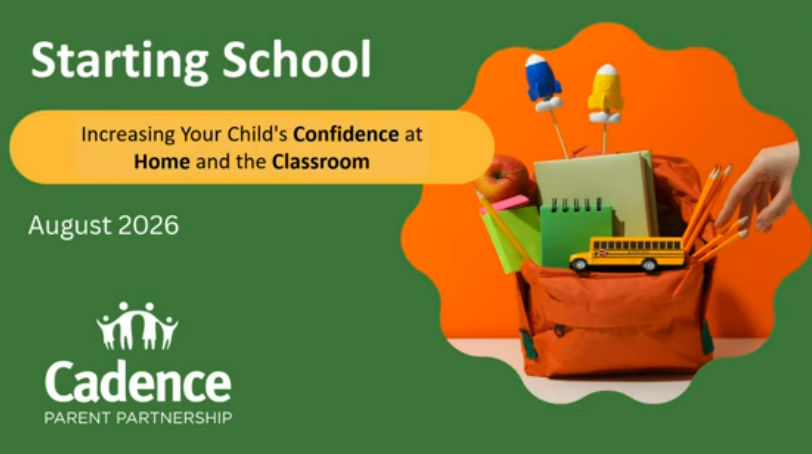
In today’s conversation, we’re going to discuss a topic that many parents asked about, and the timing happens to be perfect for back-to-school season. Starting school: increasing your child’s confidence and comfort. Starting school and managing changes is something that all young children will experience. And whether you’re a new parent or a seasoned one, understanding barriers to developing confidence for managing change and having some tips to rely on can make this experience more manageable and positive for you and your child.
We’re so glad you’re here with us, and we’re looking forward to sharing insights and strategies during this session.
Meet Today’s Speakers
I’m Maggie Walsh, the chief academic officer here at Cadence Education. I bring over 25 years of experience as a classroom teacher and provider of teacher and leader professional development. Joining me today is my colleague Shelley.
Hi, my name is Shelley King, and as Maggie mentioned, we’re here today to lead this conversation with you. I’m very honored to be a part of the Cadence Education family. I have more than 35 years of experience in teaching, supporting leadership and school leaders in the education and classroom, and more. I also would like to share that part of my honor and opportunity in the Cadence family, as the senior director of classroom experience, is to work with school leadership as well as educators in the classroom to help create environments, curriculum, and activities that help children thrive in their early years.
I also have had the opportunity—and I would say a little bit of excitement and a little bit of fear—of sending four children not only to pre-K and kindergarten but to elementary school, junior high school, high school, and then off to college. So I do understand a little bit of the excitement you have and also a little bit of the nerves that come with that for you and your child.
What You Will Learn Today
So today’s conversation, I’m excited to help lead us through the discussion as we talk about how we support our children and a little bit of ourselves through different milestones and transitions that come. Our goals today are to learn a little bit of practical strategies that can help you not only prepare them for a new classroom, a new school, or new experiences, but also to help you understand what to expect when they’re going through transitions and milestone periods, as well as how to support the social and emotional well-being of you and your child through these transitions.
Essentially, something that we want to do is think about not just having them survive these transitions and changes, but thrive through them and build what will become a growth mindset that will stay with them through their lifetime.
“The Only Thing That Is Truly Constant Is Change”
We think that this phrase is just fitting and perfect for today’s conversation: The only thing that is truly constant is change. We all experience change in our lifetime. And to put it into context, statistics tell us that the average human is going to meet and build relationships with up to 10,000 new people in the course of their lifetime. For me, that’s a really exciting thing. For others, it may not feel as exciting and may bring some emotion and feeling.
Studies also show us that everyone experiences at least one significant change each year of their life. And those types of changes—bigger, smaller, more challenging, or maybe even the positive and exciting ones—are going to be very different for all of us. But what we know is that we all experience change throughout our life. And that means our children as well. They’re experiencing some drastic change as they’re developing over the years.
These changes can be exciting and bring big emotions and a lot of outcomes that we have to look forward to, but they can also bring big emotions with fear and nerves for both us and our children. So by supporting them through this change, we can help them build resilience, self-confidence, and, again, that growth mindset that they need.
As we think a little bit about the changes that children experience, not only in the world but also within themselves as they’re developing, Maggie’s just going to share some insight with us so we can start with understanding our children and the changes they experience.
How Infants and Young Children Are Wired to Manage Change
To help prepare children to manage changes, it helps first to understand how infants and young children are wired to manage the world around them. A child’s brain and body are uniquely designed to help them process changes and various life experiences. For example, an infant is born with about 100 billion neurons that they will use during their lifetime. These neurons will be used to make the connections needed as their brain develops.
Young children learn emotional responses from the world around them. Children learn from adult models like us. Infants are born initially with about six key emotions, mostly related to their senses. Then, as they grow, they will develop these emotions and learn more. The way that we manage responses and reactions is a model for infants and children. They will develop new emotions and learn to recognize, label, and manage them. The way that we prepare them and help them with their emotions and responses today helps play a big role in their resilience and their adaptability in the future. Two of the most important are confidence and kindness.
Common Barriers to Your Child’s Confidence During Change
There’s so much going on within the minds of a young child, and as they face change, there are going to be some barriers to confidence. Essentially, today our focus is to help them build their backpack and pack it with tools to help them as they experience change.
As we mentioned, all of these changes can be different. They can include going to a new school, moving to a new home or neighborhood, maybe a change to a new bedroom or a bed, or maybe even a sibling. All of these are something that may be exciting for them and bring big emotion, or can be something that they are fearing or intimidated by, and this can be barriers to their confidence. We can help them overcome this by first understanding what barriers our children are feeling.
Negative Self-Talk and Lack of Coping Skills
The first one is related to negative self-talk or lack of coping skills, and they’re quite related. One way that you can help your child overcome that is to watch for signs that they’re too critical of themselves. It might be when they’re trying to do something hard or new, or something that you can do that they cannot. If you’re seeing them get frustrated too easily and they don’t have the words to express that, or the words that come out are negative toward themselves, you can help them change that language.
Just one example of that is when a child gets frustrated because they’re trying to do something and they cannot do it. They may give up and say, “I can’t do it.” We want to introduce them to the concept of yet. You may not be able to do it right now, but do your best. Let’s do it together. And let them know that yet will come and they will be able to do it. Changing their negative self-talk to a more optimistic, open talk can help them when they’re facing a barrier to confidence that’s related to change or emotions.
Balancing Overprotection and Independence
One of the other things that’s really hard for us as parents and even caregivers is to find that delicate balance between overprotection, giving them too much help and support when they need it, and too much independence. Children grow when they have opportunities to fail in a supported environment. They learn a little bit more about taking careful, calculated risks and where their limit is, and build that confidence to extend beyond that limit.
One way that we can do that is to give them some very simple tasks. It could be home chores. It could be things to be responsible for. It can be challenging them, when you’re out on a walk, to do something different that they haven’t done, but in a safe way. This allows them to build confidence when they do accomplish the task, and for you to make a big deal and celebrate it. But also, if they fail and need to try again, they’re failing in a supportive environment with you there to support, encourage, and help them if needed.
Not Understanding Expectations
One other barrier to confidence that we can experience ourselves as adults, and so we can understand why children would, is not understanding the expectation, whether it’s the expectation for themselves and what they’re supposed to do or the expectation for the environment and what’s to come. So our conversations with them can help them know what to expect. To do that, we’ll talk a little bit in a few minutes about how we can ask questions, be more curious about change, and then help them by setting up a little bit of language or storytelling that helps them know what to expect.
Learning How to Express Emotions
The last one is a little bit hard for all of us. We all have emotions, and we express them in different ways. But when we think about how we talk to our child about the way that they need to express their emotions, “use your words” is something we use a lot in the adult world. We need to remember that the way that we express our emotions, as Maggie said, helps them build positive emotions themselves or even new learned negative responses and emotions.
So essentially, we want to teach through modeling and learn to express our emotions. It’s okay to tell our child that we’re feeling a bit frustrated, tired, or that we’re nervous, too. And we also can feel better and talk through it and work through it.
Packing Your Child’s Backpack With Confidence Builders
All right. So now that we understand a little bit about the barriers—and these aren’t the only ones, so you want to observe your child and watch to see if there are other barriers that you can help them through—let’s move on to packing their backpack with confidence builders. These are just a few that we can share, first at home and with your interactions, and a little bit about how we do that in our classrooms.
Listen Actively
We want to start by modeling the approach to asking questions: asking questions about what they’re thinking, what they’re nervous about, and what they think about their new classroom. But also, when a child is sharing big emotions, or even their behaviors are changing because of a change or a transition they’re going through, you want to tap into their feelings. So first ask questions about their feelings, and then validate them.
This is very different based on the age of your child. Very young children are not going to be able to validate their feelings, so you do a bit of validating for the infant and young toddler, recognizing that they’re angry because they’re hungry or they might be cold because they’ve just gotten a bath. Then use some language while you’re doing those care and nurturing routines to work through their emotions, and recognize when they’re calm and when things are better because their needs were met. These are the early foundations to later conversations.
It’s also setting you up to encourage your child to approach new tasks, milestones, and challenges by asking questions themselves. If they’re nervous or if they’re feeling a big emotion, they can share some questions with you, and that will help you both work through and think of a way to get through or build their confidence in that emotion.
Use Visual Schedules and Calming Tools
We use some of these same skills and coping tools in our school classrooms. We use these a lot when it’s related to things like new schedules, a new environment, and new transition activities, helping a child get to know their environment and the schedule and what to expect. We often use visual schedules with pictures that tell them, “Here’s what’s happening now, and here’s what’s next.” Thinking back to them understanding, and us helping them set up and have an expectation, that builds confidence.
Also, in a classroom, there are a lot of different emotions happening at different times. So we offer different toolkits and things that children can use. We even offer different ways for them to manage their emotions in simple ways. If we’re feeling a big emotion, we can go through a breathing technique and invite them to smell the rose and blow out the candle. This is just an opportunity to take a moment to work through emotions. Using routines and tools like this can offer your child some predictability and, even in the future, offer them some ways that they can actually approach their emotions, validate them, share them, and work through them on their own.
A really good example of that is the idea of using a pinwheel to breathe in and blow out and put the energy into something positive, which kind of parks the big emotion and allows you to maybe go for a walk with your child, or sit with a family pet or friend and pet it while you open up.
Another good way to do that is through storytelling and letting them tell their story, and then helping them work through the story to change it at the end. Open-ended art is also a great way. We often find in the classroom, and you can do this at home, that offering watercolors, Play-Doh, or finger paint and sitting and just painting openly together, or doing open-ended art, can create a connection to their senses that helps calm them and then allows you to have that conversation and talk about emotions.
Our classroom toolkits include these types of things. And eventually a child may start with big emotions but can actually work through the story by choosing one so they know how it can be done.
Create a Goodbye Routine
Here are a few more confidence builders that I want to build on, and these are really things that we can do starting at home and ending at school. Create a goodbye routine. Your morning routines through your drop-off routines are really important. Creating a goodbye routine that starts at home and then continues into the car can build your child’s confidence and help them tell that story and really kind of learn what to expect for the day.
Make sure that your routines offer comfort and predictability. Think about starting from home: maybe it’s a fun cheer, or a family ritual that happens when you’re at home. Maybe it’s using a positive affirmations jar that you’ve created together, and you pull out and read something together and say the affirmation, and you take that into the car on your way out the door. The importance of the routine is that it offers predictability to your child.
Depending on the age of your child, you can actually let them pick some of those routines, and that builds some confidence in them that they get to control some of that routine. They may not be able to control that it is definitely a Monday and we had a great weekend but we need to go to school and work. They might not be able to control that, but they can control that routine alongside you. It can be as simple as “Do you want to drop your backpack off first in our routine and then greet friends?” or “Do you want me to drop your backpack and you greet friends?”
Once you have that routine, you can make slight adjustments to it, but you want to stick to the routines that they’re comfortable with and make slight adjustments that make sense to improve the routine.
Practice the Routine
You also want to practice the routine. Keep it consistent in your existing school or classroom, and then practice it as you’re approaching a new routine or new classroom. Again, a lot of these practices you can also incorporate at home when you’re changing to a new room or a new bed. A little bit of practice goes a long way.
In our schools, we often will send home letters and reminders that transition times are coming. This is a good time for you to practice stopping by the classroom that your child is going to go to. Work with your teachers during parent conferences and discussions to find out if you can do some practice. Often schools will do visit days. Take advantage of all of those things so that you can help your child in setting up and being ready for that new routine.
Be Consistent and Use Positive Reinforcement
Next is to be consistent, using positive reinforcement. There are going to be things that happen along the way in your routine. You might be running late. We might forget an item. But positive reinforcement and a little bit of storytelling that has us work through what’s happening and know that we’re going to get to the other side of it is good.
Now, there will be setbacks that come, and how we react to those setbacks, again, helps our child to understand. Oftentimes a child can be really excited about a new school, a new classroom, sleeping in a new bed, or even a new room all to themselves. And after the routine settles in, they remember what it was like and they miss that. It’s hard to let go of those things, so they will have big emotions. Those are going to come. Don’t panic. Stick to the routine. And Maggie’s also going to share with you some things that can help you as you navigate that setback.
Taking Care of Yourself During Your Child’s Transition
A couple of minutes ago, Shelley mentioned how important you are as a role model for your child. When we’re thinking about being role models, it’s important to remember that a full bucket is so much more effective when trying to be at our best. So we wanted to spend a couple of minutes just talking about taking care of you and yourself.
I’ll start by reminding you that when your child starts school or experiences change, there will likely be some challenges. Like Shelley was just talking about, these things are normal. Tears are normal on the first days, maybe even the first few weeks. And like Shelley said, you may even see some sleep, potty training, or behavior regression at home, although hopefully it’ll probably just be temporary. This is normal, as most children just need time to work out their emotions before they can thrive with consistency.
At the same time, try to keep in mind that your child can sense your emotions, too. So during these periods of change and transition, it’s important to try to stay calm and confident. Of course, it’s okay to feel your emotions as well. This is a big step for everyone in the family. Just try not to be too hard on yourself or your child.
Use the “And” Versus “But” Approach
You can also talk about your feelings with your child. When you do so, try to use what we call the “and” versus “but” approach. For example, you might say to your child, “I am feeling very nervous about your new school, and I am excited about how much you will learn.” Statements that are used with “and” can leave us focusing less on our worries and concerns and more on the positives that are coming along with them.
Observe Other Children and Help Your Child Make Friends
Help yourself and your child by observing other children at school. You could, for example, schedule a visit in the classroom, and you can point out to your child what other kids are doing and what they’re enjoying and engaged in. You can help your child be more excited about establishing their own space in their new school or new classroom, like their own special cubby, their art box, or their locker, or whatever the space is that’s designated just for them. Remind your child that everybody is special and everybody has a special place at school.
You could also suggest to your child the idea that helping other children and being a friend is a great way to make friends. Invite your child to be a friend while you also work on making friends with some parents and their children. You can work together to create a daily hello routine, which will help build community. It’s also a great example of recognizing and showing kindness to others. When your child is new to class, they might feel alone, but helping them make even just one friend can make a really big difference.
Connect With Other Parents and School Staff
The other thing you can do for yourself is to connect with other parents and school staff to give yourself extra support. Ask your child’s teacher or your school leader to share with you in Kaymbu or via a quick call just how your child is doing, especially in those early days. Encourage parents that you meet to say hello to your child during drop-off and pickup as well. Taking the time for other adults to acknowledge your child, and you doing the same for other children, again models that kind of empathy that we’re looking for and also helps your child build their confidence and security in the new classroom.
Building a Community of Kindness
Maggie shared some really good practices for helping to build that community of kindness around your child. At Cadence Education, we are really proud of what we call the Kind Child Community. It really is about building environments and adults modeling, and then children practicing these characters of kindness along the way. We understand that all families experience change not only at school but at home. And we want you to consider us part of your community of kindness.
Talk to Family and Friends
Maggie mentioned a few great ways to build relationships with teachers in the classroom, leadership at school, and even other families in the school. But a couple of other ways that you can help your child in terms of building that confidence and getting excited about change and even a new community is to talk to your family and friends. A grandma, a grandpa, an aunt, or an uncle can be a great way to help your child understand and look forward to a change or a milestone in a more positive way. They’re older, they have experiences, and they’ve been through it. So they can talk about what it was like to have a new classroom, to go to school for the first time, and they can share the positive things that happened.
Books to Read Together
Another great way to support your child is through stories: not only the stories you tell them as you build their confidence and their enthusiasm about their days, but also books to read. Libraries offer some really great resources, and you can even just use a search to help you as you search for books. These are just a few examples that we love.
- The Coffee Bean for Kids: Children can learn that they can make good things out of challenges and frustrating change that comes in the book. It’s all right. It’s okay. Through the character, a child understands it’s okay to be sad and that when we ask for help, things are going to be okay.
- The Little Black Cloud: They learn about sharing our emotions and how important that is, and the range of emotions we have. They also learn about feeling empathy for others and building in their toolbox as they help others and feel things.
- Kindness Is My Superpower: All children love to be a superhero or have superpowers. In this book, they really understand through the character that they have the power to choose an emotion and to choose to be kind and practice that every day.
So think about adding stories about kindness, things about change, books about going back to school, or milestones that are coming, to use as you prepare your child for these emotions. We’ve given you a lot of information in a little time. Maggie’s going to share with you just a little bit of ways that you can look for additional help if you need more.
Key Takeaways for Parents
I also just want to briefly recap some of the takeaways from today’s webinar. We both hope that you’re already thinking of which of these strategies you can begin to use as you help your child build confidence and kindness.
- Balance overprotection and opportunity. First, you can support your child by working to balance overprotection and opportunity, the lack of clear understanding of expectations and change, and negative self-talk.
- Use active listening and regular communication. Next thing you can do is employ your active listening skills and your regular communication, because that helps children build clear expectations and express their emotions.
- Establish routines and practice them. Next, establish routines, and don’t forget to practice them.
- Remember yourself. Finally, remember yourself and your own journey through this big change.
We will be sharing a handout with the ideas and resources that we noted in today’s session, along with a recording of this webinar, in a follow-up email sometime next week. We encourage collaboration between parents and educators at our schools to create supportive environments for children. And we want you to remember that additional help is available. If you’ve tried some or many of these strategies and you still don’t feel like things are improving, please reach out to your school director to create a plan or seek additional advice. The reality is our directors and teachers have supported so many families who have children who are new to care, transitioning to new classrooms or teachers, or just navigating other types of life’s big changes.
Q&A: Your Top Questions About Starting School and Transitions Answered
We’ve got just a couple of minutes to try to address some of the very many questions that were submitted on this topic. We have far more that were submitted than we’ll have time to answer in today’s webinar, but we are going to put together an FAQ in which we’ll work to answer the majority of the questions that were submitted on this topic. For today, we’re going to answer just two of the questions that we think represent some of the most common questions submitted by our families.
Is there a time that is too late to start school or child care that makes transitions harder? Is it better to start as young as possible?
Like I mentioned before, remember that children’s brains are at their most plastic when they’re young. By the time a child is five, their brain has already grown to 90% of its adult size. This just means that the younger they are when they’re exposed to new routines and changes, the easier and faster they will learn to adjust. With this in mind, starting school or care at a younger age is usually a good idea. That said, every family knows their child best, and each family’s circumstances are unique.
How can parents help transition their child from one room to a new room or teacher?
That’s a great question. I mentioned that our schools will send letters home to let parents know transitions are coming. Children will get the opportunity to practice, but that doesn’t always happen if you’re moving to a new classroom or a new school. So that idea of “practice makes progress” is important. Make sure you ask a lot of questions. Take time to go and visit the new classroom. Ask a little bit about what’s happening in the classroom and their routine.
Notice, even when you’re in the classroom with your child, the things that they might be drawn to and looking for, and really focus on that, whether it’s a specific area in the classroom or a specific interest that your child has. That’s really important.
And oftentimes that milestone where they’re going to a new school or a new classroom means new things that are exciting, like a new playground or a space in the classroom that their classroom before didn’t have. So consider really leaning into that. When you’re talking in the car and during your story time or over the weekend, bring it back to some of those positive things: even though change happens and it can be scary, there are really good things that come with it. So we want to be willing to move through it, address our emotions, and then look forward to those good things that come.
We know we’ll get to those other questions in our FAQ.
Upcoming Parent Webinars
We also want to note that we’re going to be hosting a variety of additional webinars on a range of topics beginning again next month in September and continuing into the spring of next year. Some of the topics that we’ll be presenting on include how to manage biting and hitting, how to prepare your child for toilet training, managing big emotions, and making the transition from pre-K into kindergarten.
We would love it if you would join us next month on September 23rd for our next webinar, which is going to be on managing meltdowns. And if you wouldn’t mind taking time to scan this QR code and give us some feedback on today’s session, we’d really appreciate it.
We are so glad you joined us today, and thank you for your time and input. Thank you, everybody.