

Webinar length: 28:22
Presenters:
- Maggie Walsh (VP of Education, Cadence Education)
- Ashley Morris (Executive Director of Montessori Schools)
Welcome and Introduction
Hello and welcome to Biting or Hitting: What You Need to Know.
We’re so happy to have you here for the third in our series of parenting webinars.
With more than 30 years in business, Cadence Education has established itself as one of the premier early childhood educators in the United States. We’re proud to serve over 30,000 families across the country, operating more than 300 private preschools and elementary schools that prepare students to thrive in their school age years and beyond.
At Cadence Education, our promise is to provide parents with peace of mind by giving children an exceptional education every fun-filled day in a place as nurturing as home. We’re committed to fostering strong relationships with their families and providing meaningful communication to support your child’s development.
The Cadence Parent Partnership Program is a new resources that we just began offering this fall. Our webinars are designed to help you navigate common parenting challenges while supporting your child’s growth and development.
We’re so pleased that you’ve chosen to spend this time with us today as we discuss a topic that many parents face: biting or hitting, what you need to know.
Biting and hitting are behaviors that many children will exhibit at some point in their early years. Whether you’re a new parent or a seasoned one, understanding reasons why this can happen and having some tips to rely on to navigate through these behaviors can make these behaviors more manageable for you and your child.
We’re so glad you’re here with us and we’re looking forward to sharing insights and strategies during this session.
Meet the Presenters
Before we dive into today’s content, let us take a moment to introduce ourselves.
I’m Maggie Walsh, the VP of education at Cadence Education, and I bring over 25 years of experience as a classroom teacher and provider of teacher and leader professional development.
Joining me today is Ashley Morris.
Hello everyone. I’m Ashley Morris, executive director of Montessori Schools, and I bring 22 years of experience in early childhood and teacher leadership.
We’re both honored to be part of the Cadence Education organization. Our goal is to support your children’s teachers, school directors, and all families as we work together to create enriching educational experiences. Thank you for allowing us to connect with you today.
Webinar Objectives
During today’s webinar, we have two objectives we want to accomplish:
- We want to share with you the main reasons that biting or hitting occur.
- We want to share some strategies that you can help manage biting or hitting when they occur, and hopefully help avoid as many occurrences as possible.
How Common Is Biting and Hitting for Young Children?
In a scientific study by the Journal of Pediatrics on normative trends and physically aggressive behavior in 2019, researchers found that 94% of all infants and toddlers engage in aggressive physical behaviors like biting or hitting between 6 months to 24 months of age, with biting subsiding between the ages of two to four.
So, if your child is engaging in either or both of these behaviors, please don’t be too concerned because it’s a very common developmental stage that most children experience. This doesn’t mean that we’re encouraging you to not learn any coping strategies. Rather, we want to remind you that you’re not alone in dealing with this and it will pass for most children.
Why Biting or Hitting Happens
There are many emotions that can end with your child biting or hitting someone, themselves, or something.
Big Emotions: Anger and Frustration
One of the most common big emotions is anger or frustration. If your child is being asked to move from one activity to another, like stop playing and come and eat or leave the park and go home, they might get frustrated and bite or hit.
Or if there is a toy that they really like and someone else is playing with it or takes it from them, they might get angry and bite or hit someone or something.
Stress and Limited Language
Stress is another emotion that can result in biting or hitting. For example, if your child is being asked to put on their coat and they can’t do it yet, or play with a toy that is too complex.
In any situation, stress can be caused by the age of your child. Young children don’t have the oral language to be able to convey their complex emotions, and that in itself causes stress, which can in turn result in biting or hitting.
Toddlers don’t yet have a lot of the tools that we take for granted for handling overwhelming situations. They don’t have robust language skills yet, so it’s hard for them to use their words to express what is bothering them.
Attention-Seeking and Exploration
Sometimes children bite or hit because they want our attention. They might be lonely. They might want to be close to us. They might just be feeling bored.
If they’ve gotten a big reaction from us in the past when they bite or hit, they might do so again in order to get our attention now.
And finally, young children are still doing a lot of learning and exploring in the world. As they try to figure out how things work, how people interact, what to do when they feel happy or sad or excited or frustrated, they bite or hit as part of this natural exploration.
Overstimulation
Biting or hitting from over stimulation is about an overheated nervous system that’s triggered the fight or flight response.
Being pushed, sometimes even an unwanted touch, tripping or being tripped, and too much noise can all result in overstimulation.
Brain Development and Impulse Control
Toddlers have not yet developed the areas in the brain that help us regulate emotions and impulses.
When an older person feels suddenly angry or overwhelmed, their brain keeps them from breaking a window before they even think about it, usually. But for a toddler, the emotion can go right into action without time to think or decide.
That’s something parents can help with by co-regulating with their toddler.
The first step of co-regulation is to make sure that you, as an adult, are calm and collected rather than getting revved up by your toddler’s mood and behavior.
If your toddler is actively being aggressive to someone, physically remove them to a safe space before working on co-regulating.
Fatigue
Another factor to keep in mind is fatigue. If your child is tired and not well rested, you might notice more biting and hitting incidents happening around these times of day.
Sensory Needs: Oral Input and Proprioception
The need for more oral input can also result in biting. Some people are stimulated by chewing and crunching and the resistance that comes with biting down on things.
This might be the reason why your child chews on their shirt or their toys, their pens, their pencils or crayons, or really seems to love crunchy foods.
Children who are seeking oral inputs might be biting on people and objects to try and get this kind of input into their sensory system.
Finally, proprioception is the ability to sense movement, action, and location in space. Children who are seeking this kind of input are usually seeking the pressure of touch to help them feel calmer.
They might be grinding their teeth a lot, which might lead them to biting people or objects.
Children who need this kind of input might be prone to hitting. They also enjoy pushing heavy objects or receiving deep squeezes or hugs. This type of feedback, this pressure of touch, helps some children to feel calmer.
Strategies to Manage Biting and Hitting
Now that we understand the typical causes behind a young child’s biting or hitting, let’s go through some specific strategies that you can work on to try and keep biting and hitting from happening moving forward.
Strategy 1: Identify Triggers
The first strategy that I’ll share that we would like you to try is to identify the triggers for a child’s biting or hitting.
This strategy is most helpful when we use it proactively. This means decide ahead of time before your child has bitten or hit someone or something that you’re going to try to watch them more carefully to see if you can figure out what is happening before the biting or hitting occur.
- Are they biting or hitting to try and help self-regulate their sensory inputs?
- Are they an oral seeker?
- What happens when they start to get upset or frustrated?
- How do they try to seek out your attention?
When we understand that biting or hitting occurs because of an unmet need, it can make it easier for you to sympathize or empathize with your child.
Children who bite or hit are not bad kids. They’re just young humans who are still learning how to appropriately express their needs, their wants, their concerns, and are learning to self-regulate their sensory inputs.
Strategy 2: Provide Replacements
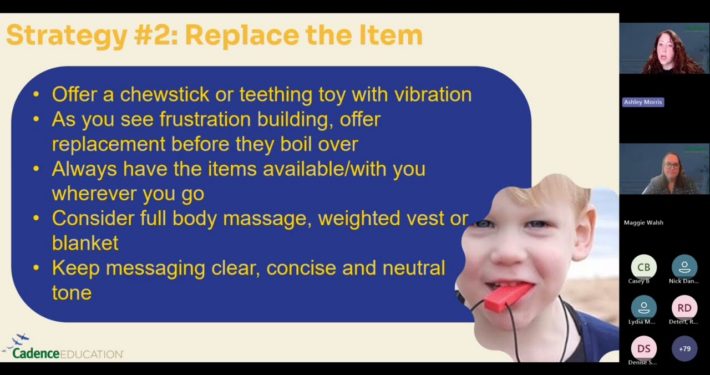
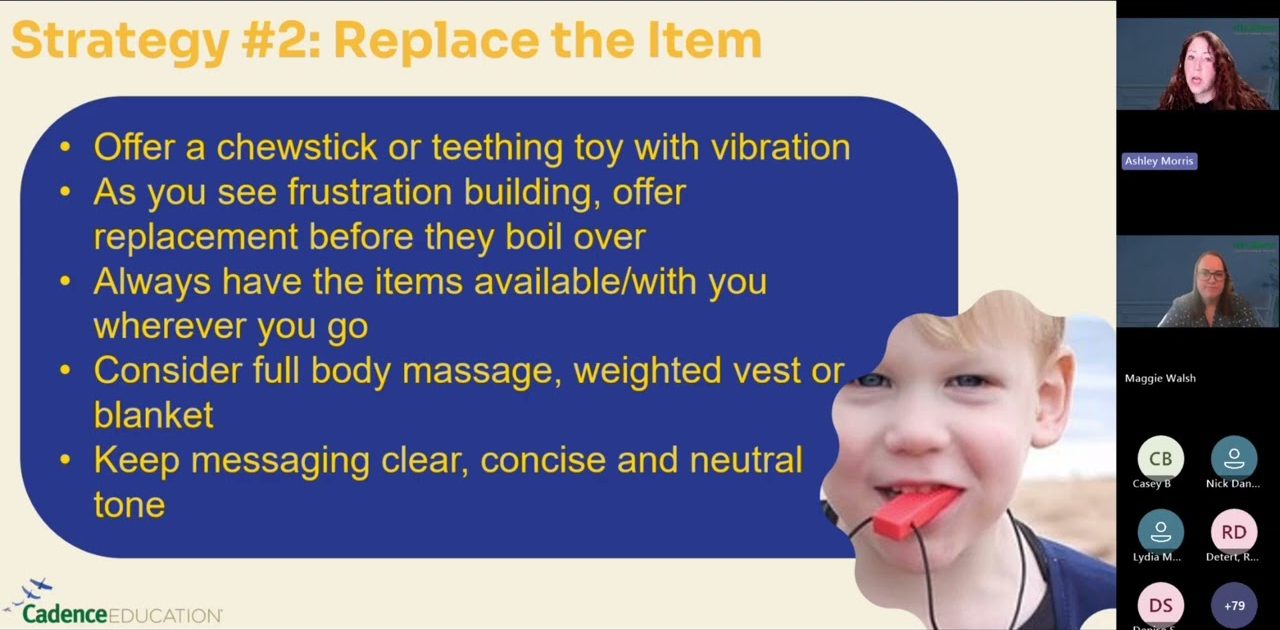
The next strategy is more about focusing on replacing the item or object being bitten or hit with something acceptable.
Don’t reward your child’s behavior by allowing them to keep whatever they’re biting, or if they took an object from another sibling or child. If they’re biting on their own clothing or body, gently remove the item from their mouth.
And you want to tell your child in a clear, concise, and neutral tone that they can’t bite or hit that person or object, but you will give them a two stick, for example, or a teether that they can bite on. Or you’ll give them a pillow or stuffed animal that they can hit or squeeze.
For this strategy to be successful, though, you must always have the replacement items with you.
- Buying several chew sticks or teething toys.
- You can have some pillows or bigger stuffed animals nearby.
- You can keep two sticks in your bag or other items in a play area or a car.
And this way you always have something as a replacement available when biting occurs.
In addition to replacing the item, consider giving your child a full body massage. Or if you have one, you can give them a weighted vest or blanket to wear for a few minutes. These options also help a child calm down and better integrate those sensory and emotional inputs.
When you speak to your child, you want to get down on their level, look them in the eye, and speak with a calm, neutral tone. And just keep it quick and concise.
Strategy 3: Offer Oral Motor Inputs
Our third strategy is one that focuses on offering your child more oral motor inputs. This strategy is especially helpful when biting occurs, but it can also help with hitting.
If you think your child is seeking the sensation, you can offer a chew tube or even gum depending on their age.
Another great option is a crunchy or a chewy snack. That’s it.
Fruit leathers are great and can be bought in bulk at Costco and Walmart. Fruits and veggies like apples, carrots, celery, cucumber, depending on your child’s age, are also good.
You can also buy vibrating toothbrushes that don’t cost that much money. They’re great for children to chew on instead of biting objects or people.
Two Breathing Exercises
In addition, there are also two breathing exercises you can teach your children as well.
Bubble mountain (at home):
You get a bowl, you fill it about halfway with water, add a few drops of dish soap, provide a straw, and then show your child how to take a deep breath in and blow into the straw and build the bubble mountain.
Besides the fact that this activity distracts your child from biting or hitting, it also helps them to self-regulate because they have to take deep breaths in and out to blow their bubbles.
Smell the flower and blow out the candle:
Have your child hold a pretend flower and take a deep breath in through their nose like they’re smelling a flower. Then have them hold the unlit candle and blow it out through their mouth.
Have them repeat this anywhere from three to five times, which can help them regulate their nervous system and move back into a more regulated state of mind.
Strategy 4: Use Redirection
Strategy four focuses on redirection. In this strategy, we choose to ignore the behavior and redirect the child with words and actions.
When we think hitting or biting is occurring because your child is attention-seeking, carefully use words and try to redirect your child’s behavior.
For example, something like this:
- I don’t like it when you bite or hit me. It hurts me.
- Then you get up and you move away and you walk away.
Or if it’s happening to someone else:
- Your brother is mad or sad or crying because you bit him or hit him. He doesn’t like that. No biting, no hitting.
Make sure that you don’t react to your child’s biting or hitting by shoving your child away, by screaming, by yelling, by hitting, or even biting back.
It’s certainly understandable that your emotions will rise when you get bit or when you get hit or your child bites or hits someone else, but children react to our energy and our emotions.
When we get worked up, they pay attention and they might end up biting or hitting more or again. When we tell them no and walk away or tell them no and move the other child away to something else, they’re going to pay attention to that as well.
So when you feel yourself getting upset, step away. Count to at least five before you speak to your child.
The calmer you are when you redirect your child, the better the outcome will be for you both.
It might be helpful to bookmark a wheel of emotions kind of like this one that we’re showing you on the screen here and keep it on your phone or print it off and leave it on your fridge or in your play area so that you can sit with your child and have them indicate how they were feeling when the biting or the hitting took place.
Helping your child identify their own emotions can help you talk with them about what they can do instead of biting or hitting when they’re having those feelings.
When they’re making an acceptable choice, narrate that behavior, too, such as, “I liked it when we played together and you didn’t hit me or bite me. I felt so happy.”
Strategy 5: Create Social Stories
Our last strategy focuses on creating social stories.
Social stories are just verbal conversations that walk your child through a situation before it happens and helps them know what is or isn’t acceptable in that situation. It gives them an option or two about what to do when they feel like they want or need to bite.
For example:
When I feel like I need to bite something or someone, I can ask for my chewing stick. Then I can bite it as much as I want and feel happy and good about my choice.
Or:
Sometimes I feel angry and I feel like I want to bite someone or myself. That’s not a good choice. But there are some things I can do instead.
- I can go to my quiet corner.
- I can ask for a hug.
- I can stomp my feet.
Or:
Even sometimes I want attention from mom or dad, so I bite or hit him or her.
And when I want mom’s attention:
- I can bring her my feelings book so she knows I want to read together.
- Or I can bring my mom my blanket so she knows I want to sit with her and cuddle.
Book Recommendations
In addition to these strategies, we wanted to identify some kid-friendly books that you could consider buying and having at home to read with your child. Many of them are also available at local libraries as well.
Books About Biting
In the upper left hand corner, we’ve got two books that are great for one to two-year-olds.
- Teeth Are Not for Biting
- No Biting
Both are definitely geared towards the youngest children.
In the lower left hand corner, we’ve got:
- Little Dinos Bite
- I Count to Four, I Do Not Bite
Which are great for 2 to four-year-olds.
Then finally on the right hand side, we have a book for slightly older children called:
- No Biting Louise
All of these books are also available on Amazon. Most of them are less than $10. Most are pretty close to about $5. We don’t think that you need to buy all of them. One or two is probably going to be more than enough to have.
Books About Hitting
In addition to the biting books, we wanted to identify some books about hitting as well.
In the upper left hand corner, we’ve got two books for 1 to 2-year-olds:
- Hands Are Not for Hitting
- No Hitting
In the lower left hand corner, we’ve got two books for 2 to four-year-olds:
- Little Dinos Don’t Hit
- No More Hitting
And then for slightly older children:
- What to Do When You Feel Like Hitting, a no-hitting book for toddlers
Again, all of these books are also available on Amazon. All of them are under $10. Most of them are closer to five. You can probably also find some of them at your local library. And you do not need all of them. One or two is probably going to be plenty.
Books About Feelings and Self-Regulation
And here are some books that you might consider buying if you realize that your child is biting because they don’t have words to express their emotions.
The upper left hand corner is for the youngest child, birth to two, which is full of photos of many children expressing the same emotion in different ways. And it can be helpful for your child to use a book like this to show you how they’re feeling even though they don’t have the oral language yet.
The upper right corner is self-regulation, and it’s told in a way that one to three-year-olds can understand and try to practice.
And then the lower left book is for two to fours and the lower right book is for four and up who have more oral language to talk about their feelings and actions.
We’re going to also send you some articles for adults and our follow-up email with a recording as well. And you can also check out Dr. Becky on Instagram, although she does tend to focus a little bit more on the primary to elementary age.
Thanks, Ashley. I’ll just put in a little extra plug for Little Monkey Calms Down, which is a favorite of my nephews who are about 3 years old. My sister reads it to them a lot and they enjoy it.
When to Ask for Extra Help
Now, if you’ve tried these strategies for, let’s say, multiple days or even weeks, and you just don’t feel like things are improving, please ask your child’s teacher for additional advice because the reality is our teachers have supported hundreds of families who have children that are biting and or hitting.
If for some reason your child’s teacher can’t help, you can also always consult your pediatrician and discuss an in-person observation.
Recap
We loved sharing this space with you all today.
As a recap, we began by understanding that biting and hitting has triggers such as frustration, new transitions, over stimulation, and exploration, understanding that these are natural development of the child and that these are natural tendencies as they learn more about navigating the world and responding to different and new experiences.
We also discussed some strategies such as:
- Observe and identify triggers
- Provide replacements
- Oral motor inputs
- Use calm words
- Create social stories
And we showed some wonderful children’s books to read for your little ones, which we will include in the resources that we will provide later on.
We hope that you found the session helpful. Remember, you are not alone in this journey. Cadence and your schools are part of the village supporting you and your child.
Q&A
We received so many different questions via the registration that you submitted and we took the time to identify a few questions that we think represent some of the most common ones that we saw.
Is biting or hitting really just a phase, or is there a way to prevent it altogether?
Okay. Well, there’s a lot of prevention and support for that infant to toddler developmental stage. However, it’s unrealistic to expect your child to not show any of these behaviors at all.
There is a form of transition happening from infancy and connection to their mother to toddlerhood and developing that sense of self. And it’s their development of those wants and needs as their brain develops, and that appropriate language and executive function skills are still developing.
So there’s a little gap that happens between those, and so we want to support that. So it is a developmental stage. It’s not going to go away completely, but we can certainly support them in it.
What’s an appropriate way to respond to an 18-month-old versus a 4-year-old who’s hitting?
A great question. First thing to do is to identify the reasons for the behavior.
For example, sometimes with younger children, they’re still figuring out the rules of how the world works and the hitting or the biting that they’re exhibiting can be very exploratory. The younger the child, the more likely it is that they’re still dealing with teething as well.
So, make sure to pay attention to your child’s triggers before the behavior, which is going to help you figure out how to manage your response.
For an older child, like a four-year-old, it’s more likely that they’re dealing with big emotions like fatigue, hunger, anger, or frustration. They can hit or bite because they don’t in the moment have the energy or the brain power to stop and express themselves with their words. So, they go straight into action.
For an older child, it’s important to help them connect their own actions with their feelings.
So, for example, you might notice something like this and say to your child:
“When you get really hungry, you get angry and then I notice you hitting more. It’s important that you eat your meal or your snack when I give it to you so that your brain and your body stay strong and calm.”
Or you might notice something like this:
“When you don’t get your way or you have to stop playing or you have to share a toy, I notice that you start to hit. I want to talk to you about things that you can do when you have those feelings instead of hitting or biting.”
Social stories and books are very helpful tools for older children.
But no matter their age, it’s still good to say no. Move away from your child when they’re upset, and also remove the item that they took or hit or bit if applicable.
Biting or hitting happens more often at school than at home. What can we practice at home?
Yeah, so this is true that the child is going to have more opportunities at school with their peers to assert their needs or concerns because there’s other children going to be invading their space.
At home, there’s not going to be as much opportunity for that, especially depending on how many siblings they have.
So, for you to add language around any emotion can help them feel supported and can be a great way to support their development of understanding when they become frustrated.
When you see your child getting frustrated over a toy, you can say something like:
“You seem frustrated. Are you frustrated? Are you mad? That toy is really difficult.”
And then that kind of provides that foundation so that when they are in a stressful situation at school and want to bite, that foundation’s been laid.
How do you work with a child who is exclusively hitting or biting one parent?
This is a pretty common occurrence with a lot of children.
Sometimes when a child spends most of their day with one parent over the other, the child feels safer taking out their aggression or their upset with the parent who spends more time caring for them, which is unfair and it feels frustrating to the adults.
The child seemingly saves up their good behavior for the parent who hasn’t spent as much time with them during the day. But this really isn’t about favoring one parent over the other. It’s just a byproduct of who’s doing more correcting and behavior management throughout the day and the child wants a break from it.
On the other hand, sometimes it’s the parent who spends less time with the child who experiences these same behaviors. Children don’t usually have the language to express their frustration or their sadness about missing their parent when they’re apart from them. Instead, it can come in the form of hitting or biting the parent.
Whatever the scenario, it’s really important that both parents work together and reinforce the same social stories and same expectations for behavior.
So, if mommy is the one being hit or bit, daddy needs to express how sad it makes him for mommy.
Daddy can tell a social story in the morning before he leaves for work about how important it is that when we’re mad or sad, we don’t hit or bite mommy because it hurts her feelings and her body.
And you don’t want to allow your child to only receive comfort from the parent who wasn’t the target of the hitting or the biting. Both parents should work together to correct and work on calming the child down.
This stage is going to pass, but it does come and go over a period sometimes of even 12 to 18 months. So, we encourage you to hang in there.
Are Cadence’s staff regularly trained to deal with these behaviors?
Cadence always trains on the topic of typical children’s behaviors like biting or hitting during our annual professional development day with our teachers.
In addition, we have monthly continuing education trainings that all teachers and leaders participate in. There is one on managing challenging behaviors that everyone takes part in every year.
Helping to manage child behaviors and developmental milestones is a big part of what preschool is for, and we weave these management strategies into almost every training module for our teachers.
There were some more questions that we saw were submitted to our Q&A and others that we didn’t get to that were submitted ahead of time. We’re putting together an FAQ where we’ll be able to follow up with you on the questions that we weren’t able to address live in today’s session.
Closing
Thank you so much for joining us today. We hope that you’ll consider giving us some feedback on today’s session.
We have this QR code that you can see on the screen here, and we’ll also include a link to the exit survey in our follow-up materials which we’ll be sending out next week along with the recording.
It will also include the titles and authors of all the children’s books that we shared and some articles just for you adults as well.
Next month on Thursday, January 22nd, we’ll be hosting another webinar which will be on the topic of fostering independence by establishing routines. And we hope you can join us again for that session.
Thanks so much for coming today and have a great afternoon.