

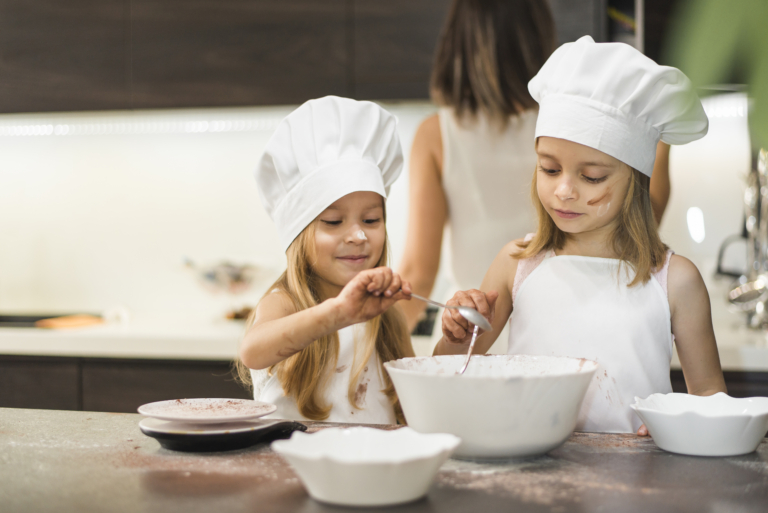
Cooking is one of childhood’s greatest adventures. In the kitchen, toddlers, preschoolers, and pre K learners get to scoop, pour, mix, taste, and make a joyful mess while discovering how things change, smell, feel, and look. Every step becomes a learning moment. Measuring flour feels like math. Watching butter melt feels like science. Stirring batter feels like a sensory celebration. And sharing a snack feels like belonging.
Children love cooking because it feels real. They get to help, experiment, problem solve, and take pride in creating something the whole family can enjoy. Along the way, they build language, early reading skills, fine motor strength, confidence, and independence without even realizing they are learning.
The activities below turn everyday kitchen moments into memory making, confidence building, hands on learning that children will want to return to again and again.
Delicious New Snack Idea: Ants Go Marching
Turn snack time into a fun learning moment by turning celery sticks into “Ants on a Log” while singing “Ants Go Marching.” This playful food activity encourages counting, sequencing, and independence while adding a musical twist children love.
Steps
- Wash and cut celery (grown-up help as needed).
- Fill celery with spread.
- Add raisins to create “ants.”
- Sing “Ants Go Marching” while preparing and eating the snack.
Materials
Celery, spread of your choice (sun butter, peanut butter, or hummus), raisins
Age-Appropriate Adaptations
- Two-year-olds — Wash and prep celery; apply spread and add raisins.
- Three-year-olds — Apply spread independently while singing and count raisins.
- Four-/Five-year-olds — Wash, cut, spread, and count raisins; track how many raisins remain after each bite.
Skills Supported
Concentration, fine motor skills, independence, following sequential steps
Scream for Ice Cream: Ice Cream in a Bag
With just a few ingredients, kids can make their own ice cream by shaking a bag full of ice and salt. This activity feels like a magic trick to preschoolers and gives them hands-on experience with measurement, temperature, and cause and effect.
Steps
- Add ingredients to a small bag.
- Place the small bag inside a larger bag filled with ice and salt.
- Shake until the mixture becomes ice cream.
- Open and enjoy.
Materials
Half and half, sugar, vanilla, ice, kosher salt, plastic Ziploc bags
Age-Appropriate Adaptations
- Two-year-olds — Pre-measure ingredients and help pour; wear gloves while shaking cold bags.
- Three-year-olds — Help measure ingredients and predict what will happen when shaking.
- Four-/Five-year-olds — Read and follow the directions independently; serve the finished treat to the family.
Skills Supported
Science exploration, sensory (hot/cold), vocabulary building, early math and measurement
Conduct Cooking Experiments with Assistance (Full Kitchen Activity)
When children cook in the kitchen, they aren’t just making food — they are exploring science, culture, sensory learning, and independence. From textures and smells to measuring and mixing, this activity allows children to experiment, problem-solve, and connect to meaningful family traditions.
Steps
- Choose a kid-friendly recipe.
- Smell, touch, and mix ingredients.
- Compare textures before and after cooking.
- Taste and discuss what changed.
Age-Appropriate Adaptations
- Two-year-olds — Smell, taste, and mix ingredients; use cooking tools; explore recipe books with photos.
- Three-year-olds — Follow a recipe and talk about family food traditions and diversity.
- Four-/Five-year-olds — Shop for ingredients, measure independently, and explore cultural foods through videos or books.
Skills Supported
Language development, critical thinking, sensory learning, mathematics, cultural understanding, bonding
Find That Fruit!
Matching colorful fruits gives children a playful way to learn about shapes, colors, and healthy foods. This hands-on sorting activity builds early math and language skills and encourages conversations about foods your family enjoys.
Steps
- Present fruit shapes or pictures.
- Match fruits by shape and color.
- Talk about fruit names and characteristics.
- Turn it into a puzzle or memory game.
Age-Appropriate Adaptations
- Two-year-olds — Match fruits with one-on-one support; promote language by naming fruit shapes and colors.
- Three-year-olds — Complete puzzles with sharing and turn-taking.
- Four-/Five-year-olds — Color and cut out printable fruit shapes and attach Velcro dots to create a reusable matching board.
Skills Supported
Language and literacy, color and shape recognition, fine motor development
Recreate a Family Vacation (Food & Culture Variation)
Family memories and food go hand in hand. In this activity, children recreate a special snack or recipe connected to a family trip, celebration, or tradition — strengthening cultural identity, belonging, and family connection through shared cooking experiences.
Steps
- Look at photos or remember a favorite family trip or gathering.
- Choose a food related to that memory.
- Prepare the recipe together.
- Share stories while eating.
Age-Appropriate Adaptations
- Two-year-olds — Look at photos or souvenirs and name familiar people and events.
- Three-year-olds — Recreate a food or tradition from a past trip (cookies, favorite treat, etc.).
- Four-/Five-year-olds — Draw or describe a favorite family trip or one planned for the future.
Skills Supported
Cultural identity, self-image, belonging, memory recall, fine motor skills
Looking for more activities?
If your child enjoyed these cooking activities, there is so much more to explore. Children learn best when they can move, create, investigate, and problem-solve across every developmental area.
Explore more preschool learning activities including art, math, literacy, science, social emotional learning, and fine and gross motor play.
→ Explore even more play-based learning activities for kids
Why Cooking Activities Matter for Toddlers, Preschoolers, and Pre K Learners
Cooking is one of the most powerful forms of hands on learning in early childhood. When young children mix, measure, scoop, pour, taste, and follow steps, they build confidence and independence while learning skills that support school readiness, daily life, and family connection.
• Cooking strengthens early math and science thinking.
Measuring ingredients, predicting what will happen during mixing or heating, and comparing sizes and quantities build early numeracy and scientific thinking (NAEYC).
• Cooking supports language development and literacy.
Talking about recipes, naming ingredients, sequencing steps, and retelling what happened during cooking builds vocabulary, expressive language, and comprehension (University of Nevada).
• Cooking enhances sensory learning and fine motor development.
Scooping, squeezing, stirring, pouring, and kneading strengthen hand muscles, hand eye coordination, and sensory processing while helping children feel calm and focused (nih.gov).
• Cooking builds independence, cultural identity, and confidence.
Participating in family food routines helps children feel capable and included while learning about family traditions, cultural foods, and belonging (NAEYC).
What This Means For Families
Children benefit every time they help wash vegetables, stir a bowl, press cookie cutters, pour ingredients, or talk about what is cooking in the kitchen. Even small responsibilities help them build independence and pride.
Food based activities naturally spark conversation and curiosity. Children learn new vocabulary, ask questions, make predictions, compare textures, count ingredients, and express their preferences. Cooking also creates meaningful moments of connection where children feel seen, valued, and included.
With simple daily routines, families can support:
✔ early math and science skills
✔ vocabulary and conversational language
✔ sensory awareness and fine motor development
✔ independence, pride, and belonging
Every playful cooking moment that involves touching, tasting, counting, pouring, or storytelling supports learning across multiple developmental areas.
Daily Play-based Learning with Cadence Education
At Cadence Education, children learn through real experiences that matter to them. Cooking and food based play are woven into the classroom to spark curiosity, build independence, strengthen language and math skills, and help children take pride in what they create. We believe learning should feel meaningful, hands on, and joyful.
We would love to meet your family and learn more about your child’s interests, strengths, and learning style.